
Generate Free Online Kundli
-
 Translate
- Astropatri Values
- My Account
Translate

December 29, 2025 Author: Tanya Singh
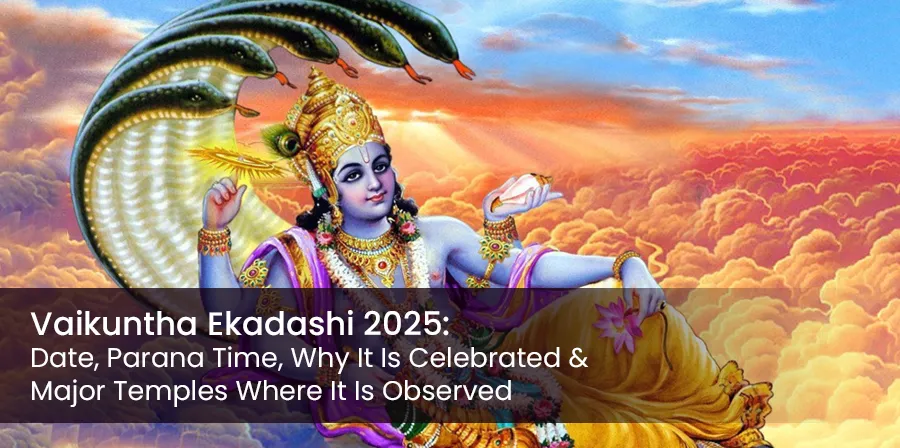
Vaikuntha Ekadashi is considered the most spiritually powerful Ekadashi of the year. Dedicated to Lord Vishnu, this sacred day is associated with liberation, surrender, and divine grace. According to belief, on Vaikuntha Ekadashi, the gates of Vaikuntha, Lord Vishnu’s celestial abode, are opened for devotees who observe the vrat with faith and discipline.
Unlike other Ekadashis that focus mainly on fasting and prayer, Vaikuntha Ekadashi carries a deeper emotional and spiritual pull. It represents the soul’s desire to move away from ego, attachment, and restlessness, and toward peace and surrender.
In 2025, Vaikuntha Ekadashi arrives at the very end of the year, making it symbolically meaningful. It offers devotees a moment to close the year with devotion instead of distraction and to step into the new year with clarity and faith.
According to the Panchang (Delhi), the Ekadashi tithi for Vaikuntha Ekadashi is as follows:
Since the Ekadashi tithi ends before sunrise on 31 December, Vaikuntha Ekadashi is observed on different days depending on tradition.
This dual observance follows long-established Ekadashi rules and is completely correct in both traditions.
Ekadashi observance depends on sunrise and tithi presence, which is why Smartha and Vaishnava traditions sometimes differ.
Smartha followers observe Ekadashi on the day when the tithi is present at sunrise. Vaishnavas follow the Gauna Ekadashi system, observing the vrat on the next day when the Ekadashi tithi has greater spiritual weight.
Both observances are rooted in scripture. What matters most is devotion, not debate.
Some deeply devoted followers even observe fasting on both days, especially on Vaikuntha Ekadashi, due to its unique spiritual importance.
Parana, the act of breaking the Ekadashi fast, must be done carefully at the correct time.
For Vaishnava Vaikuntha Ekadashi (31 December 2025):
On this day, Dwadashi ends before sunrise, so Parana must be completed during the early morning window.
For Smartha Vaikuntha Ekadashi (30 December 2025):
Parana should be done only after Hari Vasara ends and within the given time period.
Vaikuntha Ekadashi is also known as Mukkoti Ekadashi. The word Mukkoti refers to three crores of divine energies believed to be present on this day.
Sacred belief holds that on Vaikuntha Ekadashi, Vaikuntha Dwaram, the gate to Lord Vishnu’s divine abode, is opened. Devotees who observe the vrat with sincerity are believed to move closer to liberation, freedom from karmic burdens, and spiritual peace.
This Ekadashi falls during the Dhanur solar month, known as Margazhi in the Tamil calendar. Unlike most Ekadashis, Vaikuntha Ekadashi is calculated using the solar calendar, which is why it may occur once, twice, or sometimes not at all in a Gregorian year.
This unique calculation adds to its rarity and spiritual weight.
Vaikuntha Ekadashi represents letting go.
It is not just about fasting from food, but about fasting from ego, anger, pride, and emotional clutter. Devotees believe that sincere observance helps cleanse old karmic impressions and brings mental clarity.
On a deeper level, this Ekadashi encourages surrender. Instead of asking for material gains, many devotees pray for peace, forgiveness, and spiritual guidance.
This is why Vaikuntha Ekadashi is often considered the most powerful Ekadashi of the year.
Vaikuntha Ekadashi is dedicated entirely to Lord Vishnu.
Devotees may worship Him as:
Offering tulsi leaves is considered especially auspicious. Chanting “Om Namo Narayanaya” or reciting Vishnu Sahasranama is widely followed.
Even a silent remembrance of Lord Vishnu is believed to hold deep spiritual value on this day.
Vaikuntha Ekadashi is observed across India, but some temples are deeply associated with this sacred day.
The Tirumala Venkateswara Temple in Tirupati holds grand observances. The Vaikuntha Dwaram is opened only on this day, and devotees pass through it as a symbol of spiritual liberation.
The Sri Ranganathaswamy Temple at Srirangam is another major centre. Devotees gather in large numbers to witness the opening of the Paramapada Vasal, meaning the gate to the divine realm.
In Kerala, Vaikuntha Ekadashi is known as Swarga Vathil Ekadashi, which means “the gate to heaven.” The observance there is equally disciplined and devotional.
Across India, Vishnu and Krishna temples conduct night-long prayers, chanting, and early morning darshan.
Devotees usually observe a strict Ekadashi fast, avoiding grains, rice, wheat, lentils, onion, and garlic. Many follow a fruit-based or milk-based fast.
The day is spent in prayer, reading sacred texts, chanting Vishnu mantras, and maintaining silence as much as possible.
Staying awake during the night is also a common practice, symbolising spiritual alertness and surrender.
Devotees often describe Vaikuntha Ekadashi as emotionally cleansing.
It helps release inner heaviness, calm restless thoughts, and bring a sense of reassurance. Ending the year with this Ekadashi gives people emotional closure and spiritual grounding before stepping into the new year.
The observance gently reminds devotees that peace begins within.
Vaikuntha Ekadashi, observed on 30 December 2025 for Smarthas and 31 December 2025 for Vaishnavas, is far more than a ritual fast. It is a day of surrender, hope, and spiritual aspiration.
As the year ends, this sacred Ekadashi offers a rare pause to let go of burdens, reconnect with devotion, and seek Lord Vishnu’s grace.
Observed with sincerity, Vaikuntha Ekadashi is believed to open not just the gates of Vaikuntha, but also the inner doors of peace and clarity.