
Generate Free Online Kundli
-
 Translate
- Astropatri Values
- My Account
Translate

January 28, 2026 Author: Tanya Singh
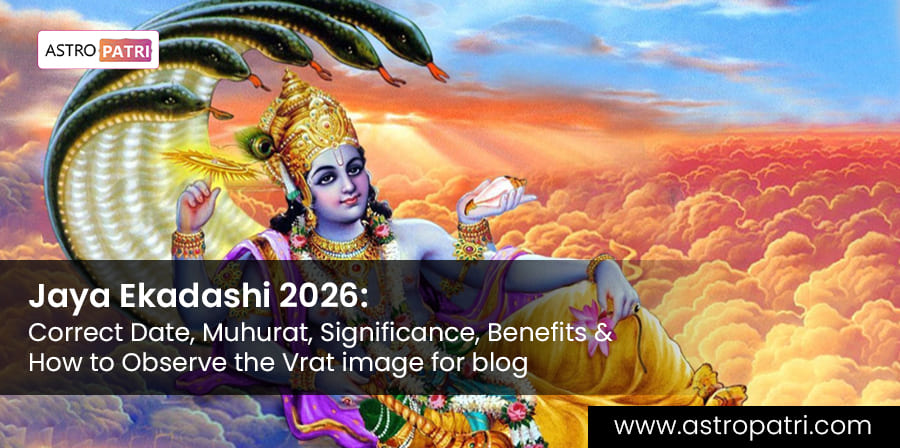
Jaya Ekadashi is not a festival of noise or display. It does not rely on grand rituals or outward celebration. Its power lies in stillness. It is a vrat that works quietly on the mind, the emotions, and the karmic layer beneath daily life. Observed during the Shukla Paksha of the Magha month, Jaya Ekadashi is dedicated to Lord Vishnu and Goddess Lakshmi and is believed to help devotees release accumulated karmic burdens, emotional heaviness, fear, and inner confusion.
In a world that constantly pushes speed, desire, and distraction, Jaya Ekadashi asks for restraint. It asks for a pause. Even for those who do not observe fasts regularly, this Ekadashi offers a chance to step back and realign with clarity and discipline.
Jaya Ekadashi will be observed on Thursday, 29 January 2026. This date is considered fully correct according to traditional Panchang rules because the Ekadashi tithi is present at sunrise on this day. In Vedic timekeeping, a vrat is always observed on the day when the relevant tithi touches sunrise, not merely when it begins or ends.
Since sunrise is the deciding factor, 29 January 2026 is the valid and religiously accepted date for observing Jaya Ekadashi vrat.
Because the Ekadashi tithi continues well beyond sunrise on 29 January, the observance of Jaya Ekadashi on Thursday is fully aligned with Vedic calculations and suitable for householders, temples, calendars, and media references.
Parana is not merely eating after fasting. It is a ritual completion of the vrat. Breaking the fast at the wrong time is believed to reduce or disturb the spiritual benefit gained through Ekadashi observance.
This time period is considered ideal because it begins after sunrise, avoids Hari Vasara, and remains within the Dwadashi tithi.
Jaya Ekadashi is believed to work at a deep karmic and emotional level. Unlike fasts focused only on external discipline, this Ekadashi emphasizes inner restraint and clarity of intention.
Traditional belief associates Jaya Ekadashi with:
For modern life, the vrat carries symbolic meaning. It teaches moderation in consumption, restraint in speech, and awareness in thought.
The significance of Jaya Ekadashi is explained through the story of Gandharva Malyavana and Pushpavati. According to the Ekadashi Purana, the Gandharva Malyavana fell into indulgence and negligence of duty, which resulted in a curse that reduced him and his wife to a lower state of existence.
Despite their condition, they unknowingly observed Jaya Ekadashi. Through the merit of this observance, they were freed from the curse and restored to their divine form.
The story carries a clear message. Even unintentional discipline, when aligned with divine order, can lead to redemption. Jaya Ekadashi does not judge the past. It offers release through restraint and remembrance.
Different traditions observe Ekadashi in different ways.
Each method respects different levels of spiritual discipline while maintaining devotion as the central element.
The observance of Jaya Ekadashi begins a day earlier, on Dashami.
Mental preparation is as important as dietary restraint. Entering Ekadashi with a settled mind enhances the effect of the vrat.
Devotees may choose the type of fast according to health, age, and daily responsibilities.
Nirjala Fast
No food and no water throughout the day. This is the strictest form and should only be followed by those with strong health and prior experience.
Phalahar Fast
Consumption of fruits, milk, nuts, and water. This is the most commonly followed and balanced form of fasting.
Single Meal Fast
One simple grain-free meal taken in the afternoon or evening.
The sincerity of the fast matters more than its strictness. A peaceful fast is always more beneficial than a forced one.
Allowed foods include fruits, milk, curd, nuts, sabudana, potatoes, and vrat-approved ingredients.
Elaborate rituals are not required. Even a few moments of focused devotion are considered effective.
The emphasis is on awareness, not duration.
Ekadashi is also a mental and emotional detox.
Staying awake at night while chanting Vishnu’s name or listening to devotional content is considered auspicious. Even partial night awareness is acceptable. The focus should remain calm and steady, not forced.
Acts of charity after Parana are encouraged. Donating food, clothes, or essentials and practicing forgiveness quietly enhance the spiritual merit of the vrat. Compassion is considered a natural extension of the Ekadashi discipline.
Jaya Ekadashi is not about perfection. It is about intention, restraint, and awareness. Even a simple fast, when practiced with sincerity, is believed to bring clarity, peace, and inner balance.
In a restless world, Jaya Ekadashi offers steadiness.
In a noisy world, it offers silence.
Jaya Ekadashi kab hai 2026?
Jaya Ekadashi 2026 will be observed on Thursday, 29 January 2026.
Jaya Ekadashi vrat katha kya hai?
The vrat katha tells the story of Gandharva Malyavana and Pushpavati, who were freed from a curse through the power of Jaya Ekadashi.
Jaya Ekadashi ka mahatva kya hai?
Jaya Ekadashi helps remove karmic burdens, emotional heaviness, and spiritual stagnation.
Jaya Ekadashi ki aarti kaun si hoti hai?
Devotees usually perform Vishnu Aarti or Lakshmi Narayan Aarti.