-
 Translate
- Astropatri Values
- My Account
Translate
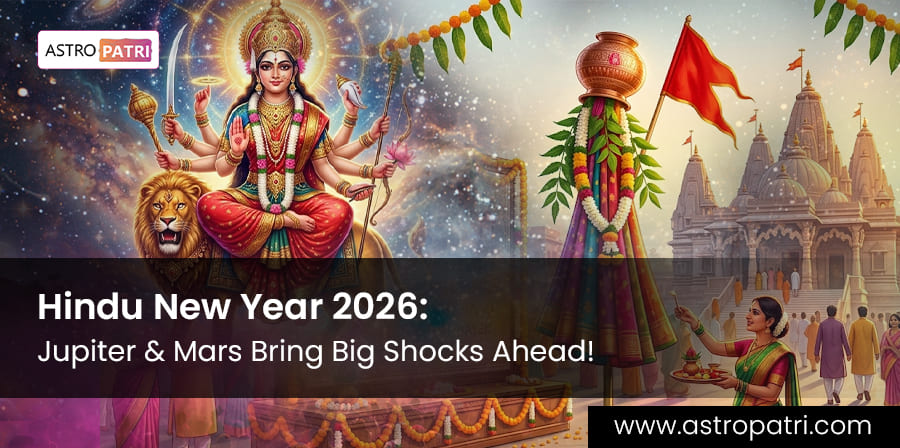
The Hindu New Year in 2026 opens with a rare mix of intensity and guidance. Beginning on Thursday, 19 March 2026, this new cycle marks the start of Vikram Samvat 2083, also known as Rudra Samvatsar. The name itself suggests a year of strong movement, correction, and transformation rather than comfort and ease.
This year begins under a unique lunar condition. The first day, Chaitra Shukla Pratipada, is observed as a Kshaya Tithi, which means the tithi starts after sunrise on 19 March and ends before sunrise on 20 March. Such occurrences are not common and are often seen as indicators of shifts that may not follow a predictable pattern.
At the same time, Chaitra Navratri also begins on 19 March, starting the nine-day worship of Goddess Durga. The festival continues until 27 March, with Durga Ashtami and Mahanavami falling together on 26 March, and the Navratri fast concluding on 27 March. Ram Navami, marking the birth of Lord Ram, will be observed on 26 March for Smarta followers and 27 March for Vaishnav followers.
Alongside these spiritual markers, the year is defined by its planetary leadership. Jupiter takes the role of King, guiding the year with wisdom and expansion, while Mars becomes the Minister, shaping how decisions are executed. This combination sets the tone for a year where thoughtful planning meets strong action.
In Vedic astrology, the year is not ruled by a single planet alone. A full council of planetary roles is assigned, each governing a specific area of life.
For Rudra Samvatsar 2026, the structure is as follows:
This ten-member planetary council provides a broader understanding of how different sectors may behave during the year.
The King of the year is determined by the weekday on which the Hindu New Year begins.
Since Thursday is ruled by Jupiter, it becomes the King of the year.
Jupiter represents wisdom, ethics, spirituality, and expansion. Its rulership often brings a structured and thoughtful approach to leadership and decision-making.
The Minister is decided based on Mesha Sankranti, when the Sun enters Aries.
Mars, being the ruler of Tuesday, becomes the Minister.
Mars represents action, courage, and execution. It influences how decisions are implemented and how quickly situations move.
The term “Rudra” is associated with a powerful and transformative force. It does not always indicate ease. Instead, it points toward correction, intensity, and necessary change.
In practical terms, this year may bring:
When combined with Jupiter and Mars, this energy becomes more directed. Jupiter offers guidance, while Mars provides the strength to act.
The presence of a Kshaya Tithi at the start of the year suggests irregular patterns. This may reflect in:
While overall rainfall may remain within normal limits, certain regions may experience an imbalance.
The planetary positions at the start of the year indicate that Jupiter, Mars, and Saturn are in a challenged state. This may create pressure on governance systems.
Possible outcomes include:
There may be visible tension between ruling authorities and opposing forces.
The influence of Rudra energy and Mars may lead to:
At the same time, Jupiter’s presence may prevent situations from becoming completely unstable, offering balance and guidance.
Despite challenges in governance, the year shows support for trade and business activities.
However, individuals are advised to remain cautious with investments. Sudden changes or volatility may affect financial decisions.
The year will also be shaped by important planetary movements:
These shifts may bring:
Such transits often create turning points that influence both personal and collective experiences.
The most defining feature of 2026 is the balance between Jupiter and Mars.
Together, they create a year where:
However, balance remains important. Acting without thinking may create conflict, while overthinking may slow progress.
On a personal level, this year may feel different from the previous one.
This is a year that rewards awareness and effort.
The Hindu New Year, beginning on 19 March 2026, marks the start of Rudra Samvatsar, a year shaped by both intensity and direction. With Jupiter as King and Mars as Minister, the year carries a mix of wisdom and action.
While certain challenges may arise in governance, climate patterns, and social stability, there is also strong potential for growth, innovation, and structured progress. The key lies in balance.
This year is not about moving blindly or waiting endlessly. It is about understanding clearly and acting at the right time.





Instant Report Based on Our Proprietary Framework, Developed by Experts