 List of Hindu Festivals
Generate Free Online Kundli
-
 Translate
- Astropatri Values
- My Account
Translate

Hindu festivals are a natural part of everyday life. They are not only about celebration, but also about meaning, tradition, and a sense of connection.
Each festival marks something important. Some celebrate the victory of good over evil, like Diwali and Dussehra. Some honour divine events, like Janmashtami and Ram Navami. Others are linked to seasons and harvest cycles, such as Makar Sankranti and Holi.
There is also a wide regional diversity. The same festival can be observed in different ways across India. In one place, it may be centered around rituals, while in another, it may focus on community gatherings or local traditions.
Another thing people often notice is that festival dates change every year. This is because most Hindu festivals follow the lunar calendar, where dates are based on tithi, or the position of the moon. Since this cycle does not match the regular calendar exactly, the dates shift each year. Some festivals, like Sankranti, follow the solar cycle and usually fall on fixed dates.
This system keeps festivals connected with natural cycles rather than fixed numbers. Over time, it creates a steady rhythm that people follow throughout the year.
This Festival page brings everything together in one place, so you can understand each festival and keep track of important dates with ease.
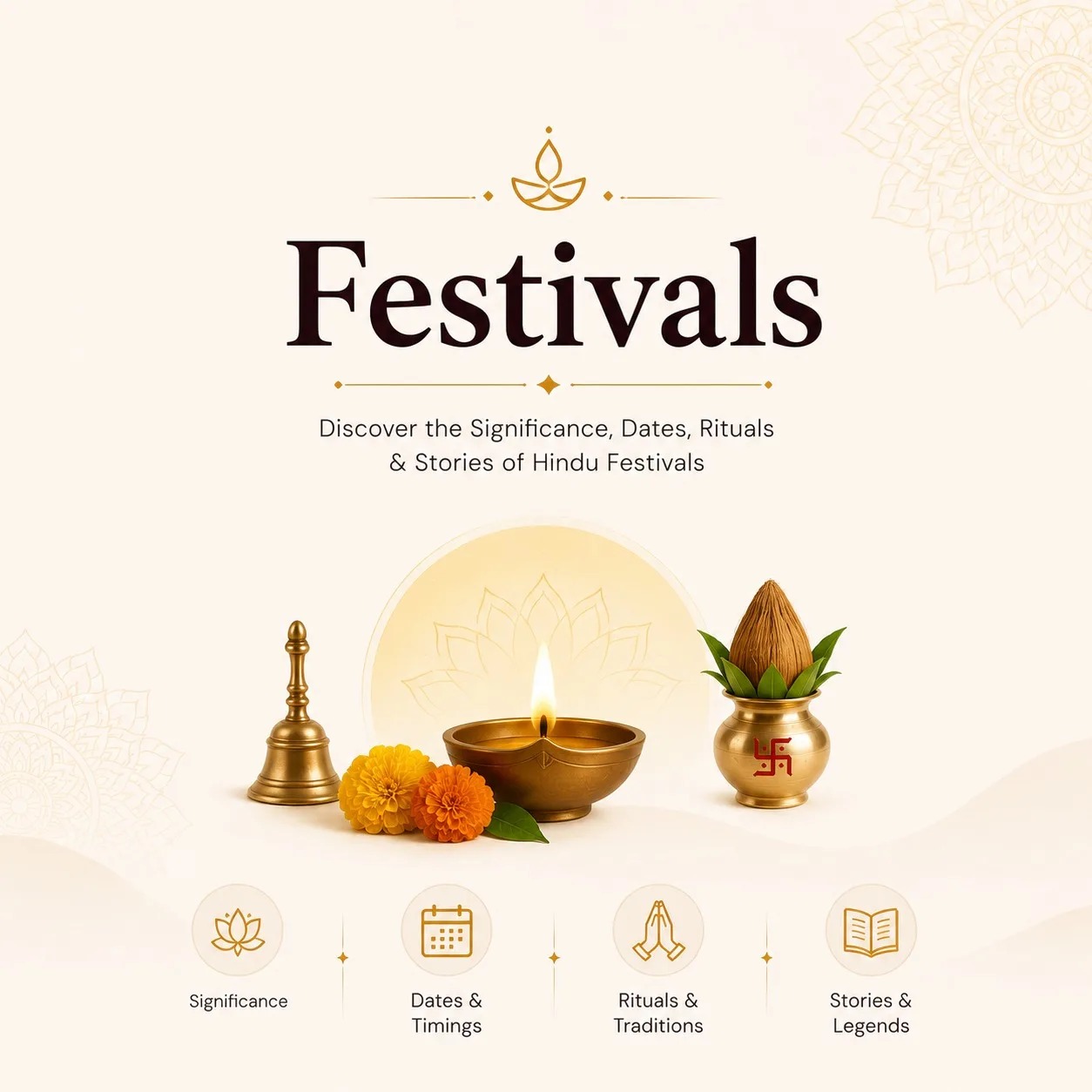
Hindu festivals cover a wide range of beliefs, traditions, and regional practices. Some are celebrated across the country, while others hold special importance in certain regions or communities. Despite these differences, many festivals share common themes of devotion, renewal, and togetherness.
Here are some of the most important and widely observed Hindu festivals:
Each of these festivals has its own rituals, stories, and significance. Together, they form a cycle that brings both spiritual meaning and cultural richness throughout the year.
You can explore each festival in detail through dedicated pages, including its date, rituals, and significance.
You can explore Hindu festivals month by month to understand how they are spread across the year. Each month carries its own mood, shaped by seasons, traditions, and important religious observances.
Hindu festivals are not only about rituals or celebration. They carry layers of meaning that touch spiritual life, social bonds, and the natural world. Each festival adds something to the way people think, live, and connect with others.
At the heart of every Hindu festival lies a spiritual purpose. These occasions remind people of values such as truth, patience, devotion, and balance.
Festivals like Diwali represent the victory of light over darkness, while Maha Shivratri encourages introspection and inner stillness. Janmashtami and Ram Navami mark the birth of divine figures whose lives continue to guide human conduct.
Observing these festivals, whether through prayer, fasting, or simple remembrance, helps create a pause in daily life. It allows a person to step back, reflect, and reconnect with deeper beliefs.
Festivals also play an important role in bringing people together. Families gather, traditions are passed down, and communities celebrate as one.
From sharing sweets during Diwali to playing colors on Holi, these moments create a sense of belonging. They strengthen relationships and keep cultural practices alive across generations.
Different regions celebrate the same festival in their own way. This diversity adds richness without breaking the shared thread of tradition. It shows how one belief can take many forms while still feeling familiar.
Many Hindu festivals are closely linked with nature and seasonal cycles. They mark changes in weather, harvest periods, and agricultural rhythms.
Makar Sankranti signals the transition of the sun and the harvest season. Holi welcomes the arrival of spring. Festivals like Baisakhi and Pongal are directly connected with farming and gratitude for crops.
This connection reflects an older way of life where human activity moved with nature. Even today, these festivals remind people of that bond and the importance of balance with the environment.
Some festivals stand out because of their wide acceptance, deep meaning, and strong cultural presence. These are celebrated across most parts of India and are often considered the backbone of the Hindu festive calendar.
Known as the festival of lights, Diwali marks the victory of light over darkness and good over evil. Homes are lit with diyas, families come together, and prayers are offered to Goddess Lakshmi for prosperity.
Link: /festival/diwali-2026/
Holi celebrates colors, joy, and the arrival of spring. It also carries the message of letting go of the past and welcoming new beginnings. The festival begins with Holika Dahan and continues with color celebrations the next day.
Link: /festival/holi-2026/
Navratri is a nine-day period dedicated to Goddess Durga and her different forms. It is observed with fasting, prayer, and cultural events. The festival ends with Durga Puja or Dussehra.
Link: /festival/navratri-2026/
Dussehra marks the victory of Lord Ram over Ravana. It symbolizes the triumph of righteousness and truth. Effigies of Ravana are burned, and the day is seen as a reminder of moral values.
Link: /festival/dussehra-2026/
Janmashtami celebrates the birth of Lord Krishna. Devotees observe fasting, sing devotional songs, and participate in midnight celebrations marking Krishna’s birth.
Link: /festival/janmashtami-2026/
Maha Shivratri is dedicated to Lord Shiva and is observed with fasting, night-long prayers, and meditation. It is considered a powerful time for inner reflection and spiritual growth.
Link: /festival/maha-shivratri-2026/
Each of these festivals has a detailed guide covering rituals, timing, and significance, helping you understand not just when to celebrate, but why.
Hindu festival dates do not follow the regular calendar in a fixed way. Instead, they are based on a traditional system that combines the movement of the moon, the sun, and local time calculations. This is why the same festival falls on different dates each year.
Understanding this system helps make sense of how and why festival timings change.
Most Hindu festivals are decided using the lunar calendar. Each day in this system is called a tithi, which is based on the relative position of the moon.
A lunar month has 30 tithis, divided into two phases:
Many important festivals are linked to specific tithis:
Since the lunar cycle is shorter than the solar calendar, these tithis shift each year. This causes festival dates to change.
Some festivals are based on the movement of the sun rather than the moon. These are called Sankranti-based festivals.
Sankranti occurs when the sun moves from one zodiac sign to another. For example:
These festivals usually fall on nearly fixed dates each year because they follow the solar cycle.
Festival dates can also vary slightly depending on the region. This happens because calculations are based on:
As a result, a festival may be observed on one day in North India and on a slightly different day in South India.
The system behind Hindu festival dates may seem complex at first, but it follows a precise and time-tested method.
Rather than fixed dates, festivals are aligned with natural cycles of the moon and sun. This keeps them connected to time in a deeper way, creating a living calendar that shifts, yet remains consistent in meaning.
Hindu festivals are mostly based on the lunar calendar, where dates depend on the position of the moon (tithi). Since the lunar cycle is shorter than the solar year, festival dates shift annually.
Lunar-based festivals depend on moon phases (like Diwali and Holi), while solar-based festivals (like Makar Sankranti) follow the sun’s movement and usually occur on fixed dates.
A tithi is a lunar day calculated based on the angular distance between the sun and the moon. Each lunar month consists of 30 tithis.
Festival dates may vary due to differences in local panchang (calendar calculations), as well as sunrise, sunset, and moonrise timings in different regions.
Some of the most widely celebrated festivals include Diwali, Holi, Navratri, Dussehra, Janmashtami, and Maha Shivratri.
Hindu festivals hold spiritual, cultural, and seasonal importance. They promote values like devotion, unity, gratitude, and harmony with nature.
Many festivals align with seasonal changes and agricultural cycles. For example, Holi marks the arrival of spring, while Makar Sankranti is linked to harvest season.
Sankranti refers to the transition of the sun from one zodiac sign to another. Festivals like Makar Sankranti are based on this solar movement.
Shukla Paksha is the waxing phase of the moon (from new moon to full moon), while Krishna Paksha is the waning phase (from full moon to new moon).
You can explore the full month-wise Hindu festival calendar for 2026 on this page, along with detailed guides for each festival including dates, rituals, and significance.
Instant Report Based on Our Proprietary Framework, Developed by Experts