Generate Free Online Kundli
-
 Translate
- Astropatri Values
- My Account
Translate

February 6, 2026 Author: Tanya Singh
Every year as Holi approaches, one question dominates conversations across homes, offices, schools, and social media timelines: Holi kab hai?
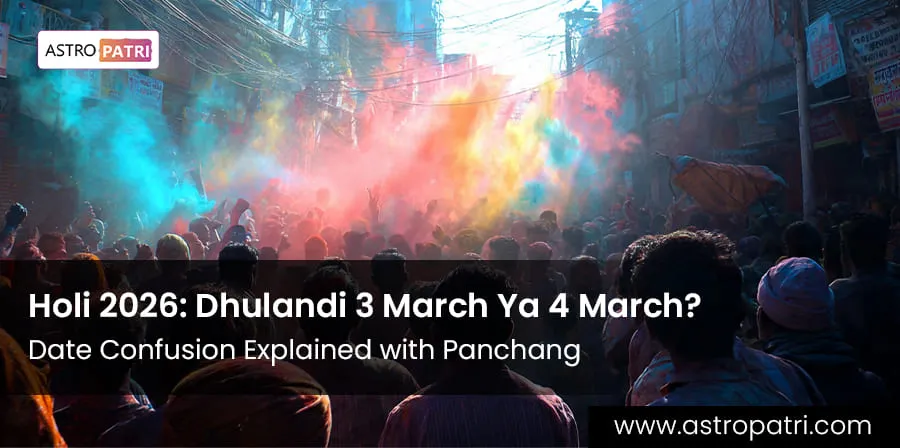
In 2026, the confusion is sharper than usual. Many calendars mention 3 March, while others highlight 4 March, leaving people unsure about the actual date of Rangwali Holi or Dhulandi.
So, is Holi on 3rd March or 4th March in 2026?
The clear and correct answer is this: Holi is celebrated over two days, and Rangwali Holi (Dhulandi ) falls on 4 March 2026.
To understand why, one must look beyond the modern calendar and into the Hindu Panchang system, which governs all traditional festival dates.
This article explains the exact date of Holi 2026, the Purnima tithi logic, the difference between Holika Dahan and Rangwali Holi, and why this confusion happens every year.
If you are planning travel, school holidays, rituals, or community events, this guide gives you complete clarity.
| Occasion | Day | Date |
| Holika Dahan (Chhoti Holi) | Tuesday | 3 March 2026 |
| Rangwali Holi / Dhulandi | Wednesday | 4 March 2026 |
Final answer: Dhulandi or Rangwali Holi will be celebrated on 4 March 2026.
Holi is not a single-day festival. Traditionally, it unfolds over two distinct days, each with a separate spiritual and cultural meaning.
The confusion arises because Hindu festivals are calculated using the Panchang, not the midnight-to-midnight Gregorian calendar most people follow today.
Because the Purnima tithi does not align neatly with modern calendar dates, two consecutive dates often get associated with Holi celebrations.
| Tithi Detail | Time & Date |
| Purnima Tithi Begins | 2 March 2026, 5:55 PM |
| Purnima Tithi Ends | 3 March 2026, 5:07 PM |
Since Purnima is present during the evening of 3 March, Holika Dahan is performed on that night.
Rangwali Holi is always celebrated the morning after Holika Dahan, which makes 4 March 2026 the correct date for Dhulandi.
Many people use the word “Holi” loosely for both days, which adds to the confusion. In reality, these are two separate observances.
Holika Dahan, also known as Chhoti Holi, takes place in the evening or night.
What it represents:
The ritual is rooted in the legend of Prahlad and Holika, where unwavering faith survives oppression.
Regional names:
Bonfires are lit, prayers are offered, and communities gather in reflection rather than celebration.
This is the day most people associate with Holi.
Key features:
Regional names include:
This is the main Holi celebration day, and it always follows Holika Dahan.
Rangwali Holi is not only about colours. At its heart, it reflects emotional renewal and social harmony.
Traditionally, the day represents:
In many households, celebrations begin with dry gulal, followed by playful colour rituals, relaxed meals, music, and shared laughter. The mood is informal, inclusive, and forgiving.
Holi in the Braj region carries unmatched cultural and devotional depth because of its close association with Lord Krishna.
| Place | Special Significance |
| Mathura | Birthplace of Krishna |
| Vrindavan | Temple-centric devotional Holi |
| Barsana | Famous for Lathmar Holi |
| Nandgaon | Krishna’s childhood village |
| Gokul | Early life celebrations |
| Govardhan | Parikrama-based rituals |
Among these, Barsana’s Lathmar Holi stands out for its symbolic tradition, where women playfully strike men with sticks, reenacting legends linked to Radha and Krishna. These celebrations often begin days before the main Holi date.
The confusion around Holi dates usually happens due to three reasons:
Understanding the Panchang logic instantly clears this confusion.
If you were confused about whether Holi in 2026 falls on 3rd March or 4th March, the answer is now precise and clear.
While Holi is remembered for its colours, its deeper meaning lies in renewal, forgiveness, and shared joy. Understanding its timing through the Panchang helps preserve both tradition and clarity.
As the festival approaches, mark your calendar correctly and celebrate Holi not just with colours, but with awareness and intention.
Is Holi on 3rd or 4th March in 2026?
Holi is celebrated over two days. Holika Dahan is on 3 March, while Rangwali Holi or Dhulandi is on 4 March 2026.
Which day is the main Holi celebration?
The main celebration with colours is Rangwali Holi, observed on 4 March 2026.
Why do some calendars show Holi on 3 March?
Because Holika Dahan occurs on the evening of 3 March. Some calendars list only the first ritual day without clarification.
Is Dhulandi and Rangwali Holi the same?
Yes. Both terms refer to the colour-playing day, which falls on 4 March 2026.
Does the Holi date change every year?
Yes. Holi is based on the Phalguna Purnima tithi, which shifts annually according to the lunar calendar.