-
 Translate
- Astropatri Values
- My Account
Translate

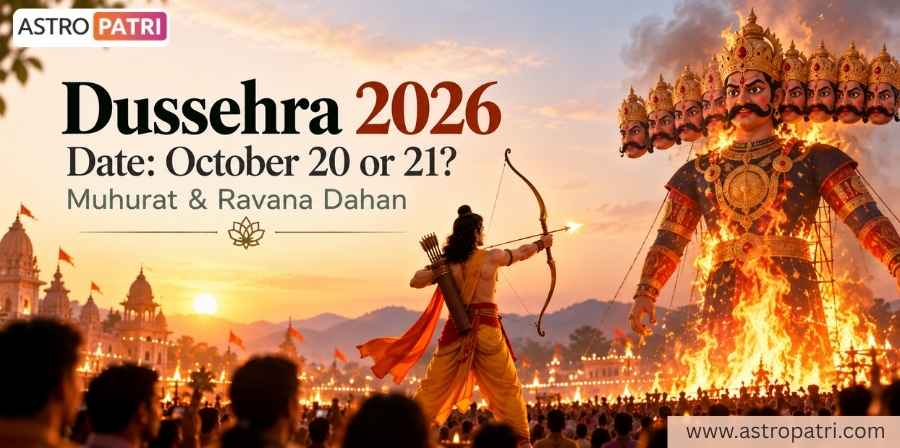
Dussehra, also known as Vijayadashami, will be celebrated on Tuesday, October 20, 2026, in most parts of India. However, the date differs in some regions, including West Bengal, Kerala and Mysuru, where Vijayadashami observances fall on October 21.
The festival marks Lord Rama’s victory over Ravana and, in another important Hindu tradition, Maa Durga’s victory over Mahishasura. If you’re planning your Dussehra puja or looking forward to Ravan Dahan, here are the festival date, Vijay Muhurat, Tithi timings and significance for 2026.
If you’re planning a puja, attending a Ramlila or waiting for the evening’s Ravana Dahan, these are the dates worth saving.
| Event detail | Date and time |
| Dussehra in most parts of India | Tuesday, October 20 |
| Durga Ashtami in New Delhi | Monday, October 19 |
| Maha Navami in New Delhi | Monday, October 19 |
| Dashami Tithi begins | October 20, 12:50 PM |
| Dashami Tithi ends | October 21, 2:11 PM |
| Vijay Muhurat in New Delhi | October 20, 1:59–2:45 PM |
| Aparahna Puja in New Delhi | October 20, 1:14–3:30 PM |
| Bengal’s Bijoya Dashami | Wednesday, October 21 |
| Mysuru Dasara Vijayadashami | Wednesday, October 21 |
The timings above are for New Delhi unless a regional celebration is specified. Your local Panchang may show different muhurat timings, so check your city before planning a ritual.
The difference comes from the timing of the Dashami Tithi, the tenth lunar day associated with Vijayadashami. This Tithi begins at 12:50 PM on October 20 and ends at 2:11 PM on October 21 in New Delhi.
Hindu festival dates are determined by lunar-calendar observances, not simply by whether a Tithi begins or ends on a particular calendar date. Regional traditions and the rules followed for observing a festival can therefore lead to different celebration dates.
For most of North India, Dussehra falls on October 20. Bengal celebrates Vijayadashami on October 21 as Durga Puja concludes, while Kerala’s learning-related observances and Mysuru’s grand Dasara procession are also associated with October 21.
Dussehra celebrates the victory of good over evil. Its significance is connected with two major stories from Hindu tradition: Lord Rama’s victory over Ravana and Maa Durga’s victory over Mahishasura.
According to the Ramayana, Ravana, the king of Lanka, abducted Mata Sita. Lord Rama, accompanied by Lakshmana and supported by Hanuman and his allies, fought a battle against Ravana to rescue her.
Rama eventually defeated Ravana and rescued Mata Sita. This victory is commemorated on Dussehra, particularly in North India, where Ramlila performances bring episodes from the Ramayana to life.
The burning of Ravana’s effigy symbolises the defeat of wrongdoing and the consequences of arrogance and misuse of power. It also reminds devotees that knowledge and strength mean little when they are not guided by wisdom and responsibility.
Vijayadashami is also associated with Maa Durga’s victory over Mahishasura, a powerful demon who threatened the balance between good and evil.
After a fierce battle, the Goddess defeated Mahishasura, restoring order and protecting the divine world. Her victory represents the strength required to confront destructive forces.
This story holds particular importance during Durga Puja in West Bengal and other parts of eastern India. While North India often marks Dussehra with Ravan Dahan, many eastern communities observe Vijayadashami through the farewell rituals for Maa Durga.
Both stories share the same central message: evil and injustice can be overcome.
Ravan Dahan is generally held on the evening of October 20, 2026, in places celebrating Dussehra on that date. The ceremony usually takes place after sunset, often following local Ramlila performances.
There is no single Ravan Dahan time for the whole country. The schedule depends on the city, local customs and the organisers of each event. Check your local Ramlila committee or event announcement for the confirmed time and venue.
During the ceremony, effigies of Ravana are often burned alongside those of Kumbhakarna and Meghnad. Families and communities gather to watch, bringing the festival to a dramatic close.
Ravan Dahan represents the victory of righteousness over wrongdoing. Ravana is remembered not only for his power and intelligence but also for the arrogance and actions that led to his downfall.
His ten heads are often interpreted in popular tradition as symbols of human weaknesses such as ego, anger, greed, jealousy and uncontrolled desire. Interpretations vary, but the broader message is clear: personal strengths can become destructive when they are not guided by sound judgment.
The ritual encourages people to reflect on the habits and attitudes they need to overcome rather than treating the defeat of evil as a story belonging only to the past.
Dussehra brings together different regional customs, each reflecting the festival’s association with victory and renewal.
The customs differ, but each gives the festival a distinctive cultural meaning.
Many Hindu traditions consider Vijayadashami a favourable day to begin new activities, pursue learning or take an important step in work and business.
Depending on family and regional customs, people may choose the day to:
In some regions, Vijayadashami is especially associated with the beginning of a child’s formal learning. The specific customs and timings vary, so families may consult their local Panchang before performing a ritual.
Dussehra is more than the burning of Ravana’s effigy. Through the stories of Lord Rama and Maa Durga, the festival celebrates courage, righteousness and the triumph of good over evil.
Whether you mark the day with Ravan Dahan, Durga Puja traditions or prayers for a new beginning, Dussehra offers an opportunity to celebrate victory while reflecting on the choices that help us move forward.
1. When is Dussehra in 2026?
Dussehra falls on Tuesday, October 20, 2026, in most parts of India. Some regional Vijayadashami observances, including those in West Bengal and Kerala, fall on October 21.
2. What is the Vijay Muhurat for Dussehra 2026?
In New Delhi, Vijay Muhurat is from 1:59 PM to 2:45 PM on October 20, 2026. The timing varies by location, so check your local Panchang for the correct muhurat.
3. What time is Ravan Dahan in 2026?
Ravan Dahan is generally held after sunset on October 20 in places observing Dussehra that day. The exact time depends on local celebrations and event arrangements.
4. Are Dussehra and Vijayadashami the same?
Yes, Dussehra and Vijayadashami generally refer to the same festival. Dussehra is widely associated with Lord Rama’s victory over Ravana, while Vijayadashami also marks Maa Durga’s victory over Mahishasura.
5. Why is Dussehra celebrated after Navratri?
Vijayadashami falls on the Dashami Tithi associated with the conclusion of Sharad Navratri. It marks the victories of Lord Rama and Maa Durga over the forces of evil in their respective traditions.
Instant Report Based on Our Proprietary Framework, Developed by Experts