-
 Translate
- Astropatri Values
- My Account
Translate

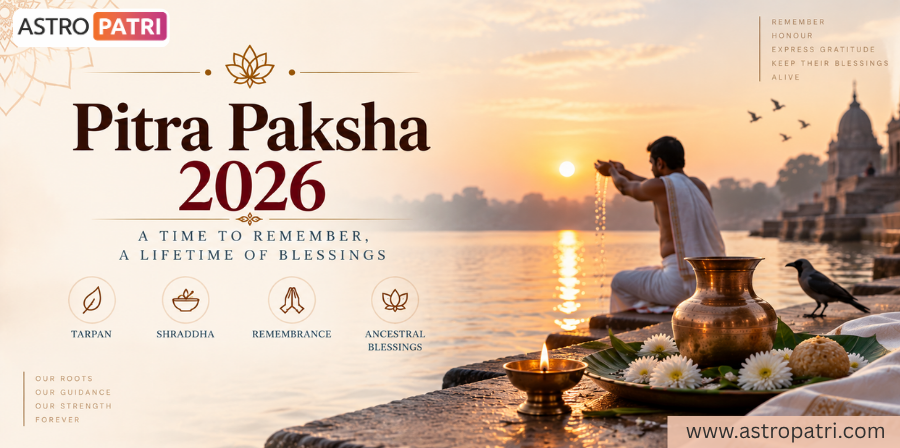
Pitra Paksha 2026 begins with Purnima Shraddh on September 26 and concludes with Sarva Pitru Amavasya on October 10. During these days, families traditionally remember their ancestors through Shraddh, Tarpan, Pind Daan, prayers, food offerings and charity.
But Pitra Paksha is not only about knowing which date falls on the calendar.
For many families, these days bring back old memories, family traditions, and rituals that parents and grandparents may have followed. It is a time to pause, remember where you came from and honour those who came before you.
It is also when many people start wondering about Pitra Dosha in their Kundli. Is it really present? What does it mean? Does everyone need remedies?
This complete guide to Pitra Paksha 2026 covers the dates, Shraddh calendar, rituals, regional traditions, what to follow during this period and how you can check Pitra Dosha in your Kundli.
According to the 2026 Shraddh calendar, Purnima Shraddh is on September 26, 2026. Pratipada Shraddh follows on September 27, and the Tithi-wise Shraddh observances continue until Sarva Pitru Amavasya on October 10, 2026.
Pitra Paksha 2026: Shraddh Calendar
| Date | Day | Tithi | Shraddh |
| September 26 | Saturday | Bhadrapada Shukla Purnima | Purnima Shraddh |
| September 27 | Sunday | Ashwina Krishna Pratipada | Pratipada Shraddh |
| September 28 | Monday | Ashwina Krishna Dwitiya | Dwitiya Shraddh |
| September 29 | Tuesday | Ashwina Krishna Tritiya | Tritiya Shraddh |
| September 29 | Tuesday | Bharani Nakshatra | Maha Bharani |
| September 30 | Wednesday | Ashwina Krishna Chaturthi | Chaturthi Shraddh |
| September 30 | Wednesday | Ashwina Krishna Panchami | Panchami Shraddh |
| October 1 | Thursday | Ashwina Krishna Shashthi | Shashthi Shraddh |
| October 2 | Friday | Ashwina Krishna Saptami | Saptami Shraddh |
| October 3 | Saturday | Ashwina Krishna Ashtami | Ashtami Shraddh |
| October 4 | Sunday | Ashwina Krishna Navami | Navami Shraddh |
| October 5 | Monday | Ashwina Krishna Dashami | Dashami Shraddh |
| October 6 | Tuesday | Ashwina Krishna Ekadashi | Ekadashi Shraddh |
| October 7 | Wednesday | Ashwina Krishna Dwadashi | Dwadashi Shraddh |
| October 7 | Wednesday | Ashwina Magha Nakshatra | Magha Shraddh |
| October 8 | Thursday | Ashwina Krishna Trayodashi | Trayodashi Shraddh |
| October 9 | Friday | Ashwina Krishna Chaturdashi | Chaturdashi Shraddh |
| October 10 | Saturday | Ashwina Krishna Amavasya | Sarva Pitru Amavasya |
The 2026 calendar places Maha Bharani on September 29 and Magha Shraddh on October 7. It also lists Chaturthi and Panchami Shraddh on September 30.
Note: Shraddh dates and ritual timings can vary according to location, Panchang and family tradition. Check the local Panchang before performing a specific ritual.
Pitra Paksha is a traditional period dedicated to remembering and honouring ancestors.
It is also referred to as Pitru Paksha or Mahalaya Paksha. The period is closely associated with Shraddh, a ritual performed for ancestors with faith, devotion and traditional offerings.
For families, the meaning can be deeply personal. It may be a time to remember a parent, grandparent or another loved one who is no longer around.
The rituals provide a traditional way to express that remembrance through prayer, offerings and acts of charity.
Pitra Paksha is important because it gives families a dedicated time to honour their ancestors and continue traditions passed down through generations.
The focus is not simply on performing a ritual correctly. The idea of remembering, respecting and expressing gratitude is central to the observance.
Traditional descriptions of Shraddh also emphasise devotion and proper observance. Textual references to Shraddh appear across several Hindu scriptures.
For many people, that makes Pitra Paksha less about fear and more about connection.
Shraddh is a traditional ritual performed in remembrance of ancestors.
Its exact form can differ between communities and families. Traditional descriptions mention offerings, sesame seeds, Kusha grass, mantras and other ritual elements.
This is why there may not be one identical Shraddh procedure followed across every part of India. Local customs and family traditions often determine how the ceremony is performed.
The most commonly associated practices include Pind Daan, Tarpan, food offerings and charity.
What is Pind Daan?
Pind Daan is a traditional offering made as part of ancestral rites.
It holds particular importance in several North Indian traditions. Sacred places such as Gaya, Badrinath, Prayag and Kashi are traditionally associated with Pind Daan.
The ingredients and method of preparing the pind can vary according to family and regional customs.
What is Tarpan?
Tarpan means making a traditional offering of water to ancestors.
Sesame seeds are commonly used during Tarpan. In Bengal, Odisha and Assam, Tarpan has a particularly prominent role in Pitra Paksha observance.
What food is offered during Shraddh?
Food offerings are traditionally an important part of Shraddh.
Depending on the custom being followed, food may be offered through priests or shared with people in need. Traditional practices may also include offerings to cows, dogs and crows.
The customs may look different from one household to another, but food remains an important part of ancestral remembrance.
Is charity important during Pitra Paksha?
Yes. Charity and acts of giving are commonly associated with Shraddh.
Donating food, helping someone in need or supporting a charitable cause can become part of the observance. Traditionally, the act of giving is viewed as an expression of goodwill and remembrance.
Do not treat every guideline as a strict universal rule. The importance of bhaav, or sincere intention and devotion, remains central to the observance.
Follow the customs of your family and community rather than assuming that the same practices apply to everyone.
Pitra Paksha is observed across India, but the rituals can vary significantly by region.
In several North Indian traditions, Pind Daan is especially important. Maharashtra and Gujarat have their own regional Shraddh practices and food customs. Bengal, Odisha and Assam are strongly associated with Tarpan, while in several southern states ancestral observances are commonly referred to as Pitru Karma.
There are also differences in how lunar months are named. The Amanta and Purnimanta calendar systems use different month names, while the relevant Shraddh observances fall on similar days.
These variations are part of India’s diverse ritual traditions.
Sarva Pitru Amavasya falls on October 10, 2026. It is also known as Mahalaya Amavasya and marks the final day of the Shraddh period in the 2026 calendar.
It is considered an important day for remembering ancestors and completing Pitra Paksha observances.
For families who cannot observe an individual Shraddh Tithi, this day can also hold particular significance for ancestral remembrance according to their tradition.
Pitra Dosha is an astrological concept interpreted through specific planetary and house combinations in a person’s Kundli.
Pitra Dosha and Pitra Paksha are related topics, but they are not the same thing.
Pitra Paksha is a traditional period for honouring ancestors. Pitra Dosha belongs to the field of Vedic astrology and is assessed through an individual’s birth chart.
That distinction matters because observing Pitra Paksha does not automatically mean that someone has Pitra Dosha.
A Kundli needs to be examined to understand whether the relevant astrological combinations are present.
Yes. Astropatri lets you check Pitra Dosha in your Kundli for free.
Instead of depending only on general information about Pitra Dosha, you can explore whether relevant combinations are present in your own horoscope.
And there is another way to go deeper.
With Astropatri AI, you can ask your personal questions about Pitra Dosha and get a personalised answer based on your Kundli.
So, you are not limited to reading what Pitra Dosha means in general. You can explore what your own chart has to say.
Check your Pitra Dosha for free or ask Astropatri AI about your Kundli.
A generic Pitra Dosha article can explain the concept. It cannot tell you what is happening in your individual Kundli.
That is where Astropatri focuses on a more personal experience.
You can check your Pitra Dosha for free, then use Astropatri AI to ask questions connected to your own chart. The experience is built around your Kundli and your concern rather than only giving you a broad zodiac-based explanation.
Whether your question is about Pitra Dosha, career, marriage, finance or another area of life, the idea is simple:
Your question. Your Kundli. A personalised Vedic astrology answer.
You can start with the free Pitra Dosha check and explore your questions with Astropatri AI.
Pitra Paksha is one of those traditions that connects the present with the people and stories that came before us.
In 2026, the observance begins with Purnima Shraddh on September 26 and concludes with Sarva Pitru Amavasya on October 10.
The rituals may vary across families and regions, but remembrance remains at the heart of the tradition.
And when your questions move from tradition to your own horoscope, Astropatri gives you a simple way to explore them. Check Pitra Dosha in your Kundli for free, or ask Astropatri AI what your chart says.
1. When does Pitra Paksha 2026 start?
Purnima Shraddh falls on September 26, 2026, followed by Pratipada Shraddh on September 27. The Tithi-wise Shraddh observances continue through the period until Sarva Pitru Amavasya.
2. When is Sarva Pitru Amavasya in 2026?
Sarva Pitru Amavasya is on October 10, 2026. It is also known as Mahalaya Amavasya and marks the concluding day of the Shraddh period in the cited 2026 calendar.
3. What is done during Pitra Paksha?
Common practices include Shraddh, Tarpan, Pind Daan, food offerings, prayers and charity. The exact rituals depend on family and regional traditions.
4. Is Pitra Dosha the same as Pitra Paksha?
No. Pitra Paksha is a traditional period dedicated to ancestor remembrance, while Pitra Dosha is an astrological concept assessed through a person’s Kundli.
5. Can I check Pitra Dosha in my Kundli for free?
Yes. Astropatri lets you check Pitra Dosha in your Kundli for free. You can also ask Astropatri AI your personal questions about Pitra Dosha and receive a personalised answer based on your Kundli.