-
 Translate
- Astropatri Values
- My Account
Translate

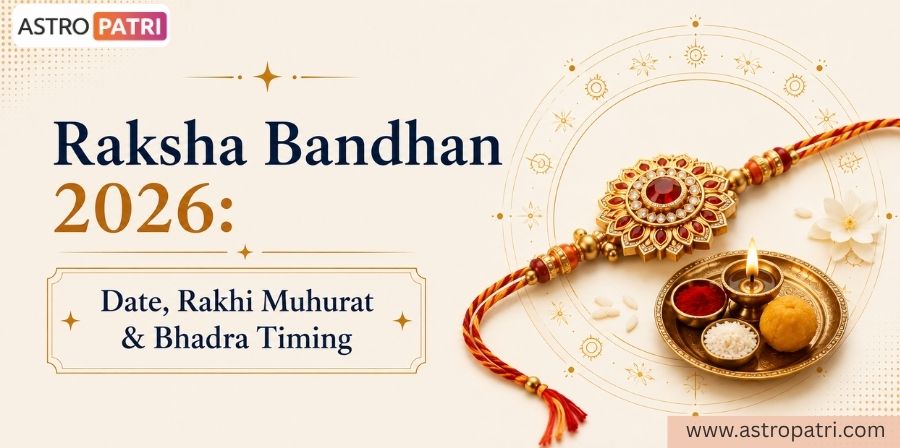
Raksha Bandhan 2026 will be celebrated on Friday, August 28. The Rakhi tying ceremony time given for New Delhi is 5:57 AM to 9:48 AM, with Bhadra ending before sunrise.
The Purnima Tithi begins at 9:08 AM on August 27 and ends at 9:48 AM on August 28.
Raksha Bandhan is widely known as the festival when sisters tie Rakhi on their brothers’ wrists. However, the older tradition has a broader meaning. The sacred thread was associated with protection, courage, health, prosperity and freedom from fear.
One of the most interesting stories connected with the festival involves Lord Indra, his wife Shachi, Guru Brihaspati and a war between the Devas and Asuras.
It gives a different perspective on why the Raksha Sutra became an important ritual on Shravana Purnima.
| Raksha Bandhan 2026 | Details |
| Date | Friday, August 28, 2026 |
| Day | Friday |
| Purnima Begins | 9:08 AM, August 27 |
| Purnima Ends | 9:48 AM, August 28 |
| Rakhi Tying Time | 5:57 AM to 9:48 AM |
| Bhadra | Ends before sunrise |
| Festival | Shravana Purnima |
The timings given above are based on the New Delhi Panchang. Local timings may differ according to the city.
Yes. Bhadra is one of the most important factors to check before performing the Raksha Bandhan ceremony.
Traditional guidance advises devotees to avoid tying Rakhi during Bhadra. Since Bhadra had ended before sunrise on August 28, 2026, the Panchang gives the morning period from 5:57 AM to 9:48 AM for the Raksha Bandhan thread ceremony.
This is especially relevant because many families traditionally tie Rakhi in the morning. Checking the day’s Panchang helps avoid choosing a time without considering Bhadra.
Today, Raksha Bandhan is mainly associated with the bond between brothers and sisters. A sister ties Rakhi on her brother’s wrist, performs aarti and prays for his well-being. The brother, in turn, promises his support and protection.
The older ritual has a wider meaning.
The Raksha Sutra was regarded as a sacred thread of protection. According to the traditional account, it was used as a spiritual safeguard against fear, illness, bad omens and other harmful influences.
This is why the name Raksha Bandhan is significant. The festival centres on Raksha, or protection, and Bandhan, or a bond.
The sibling tradition became the most familiar expression of this idea, but the underlying ritual is older than the modern Rakhi ceremony.
The traditional story mentioned in the Bhavishya Purana begins with a long and difficult war between the Devas and the Asuras.
The battle continued for twelve years.
Eventually, the Devas were defeated, and the kingdom of Indra came under the control of the Asuras. Faced with the loss of his kingdom, Lord Indra approached Brihaspati, the Guru of the Devas, for guidance.
Brihaspati advised him to perform Raksha Vidhan on Shravana Purnima.
A Raksha Potli was prepared and empowered through sacred prayers. After the ritual, Shachi, the wife of Indra, tied the Raksha Potli to Indra’s right hand.
The story says that Indra then regained his strength and defeated the Asuras, recovering his kingdom.
This story gives Raksha Bandhan a much older dimension. The Rakhi is not presented merely as a decorative thread. It represents a prayer for protection and courage.
According to this traditional account, Shachi, the wife of Lord Indra, tied the Raksha Potli to Indra’s wrist after the Raksha Vidhan performed by Brihaspati.
This is an important detail because it differs from the modern image of Raksha Bandhan as a festival exclusively between siblings.
The story places the sacred thread within a ritual of protection before the brother-sister tradition became its most familiar form.
The traditional Raksha Bandhan observance described in Vratraj is more detailed than simply tying a Rakhi.
The day begins with a ceremonial bath during Pratahkal. Deva and Pitru Tarpan are also mentioned as part of the traditional observance.
The Raksha itself is then prepared and worshipped before being tied to the wrist.
A traditional Raksha Potli is described as containing:
The Raksha Potli is placed on a clean cloth and worshipped before the ceremony.
The traditional method also mentions the worship of Bhudeva and the offering of clothes before the Raksha is tied.
For families following the simpler modern form, the ceremony usually focuses on the Rakhi, prayers, aarti, sweets and the exchange of blessings.
According to the traditional Raksha Bandhan ritual described in Vratraj, the Raksha Sutra is tied to the wrist while reciting the Raksha Mantra. The prayer refers to the protective thread associated with King Bali and asks that it remain firmly tied throughout the year.
Raksha Mantra:
येन बद्धो बलिराजा दानवेन्द्रो महाबलः।
तेन त्वामपि बध्नामि रक्षे मा चल मा चल॥
Meaning:
“I tie you with the same sacred thread with which the powerful King Bali, the lord of the Asuras, was bound. O Raksha Sutra, may you remain firm and protect throughout the year.”
Raksha Bandhan is observed on the full moon day of the Shravana month, known as Shravana Purnima.
The traditional account links the Raksha Vidhan performed for Indra with this particular day. The ritual therefore became associated with Shravana Purnima.
This also explains why Raksha Bandhan shares the same lunar date as several other important observances connected with the end of Shravana.
The modern festival is strongly associated with siblings, especially sisters tying Rakhi to brothers.
The older ritual has a wider scope. The Raksha Sutra itself represents protection and was not originally limited to a brother-sister relationship.
Over time, the sibling tradition became the dominant form of Raksha Bandhan, giving the festival the emotional character it has today.
Some families also tie Rakhi to other people with whom they share a close and protective bond.
According to the traditional guidance for Raksha Bandhan, Bhadra should be avoided for auspicious Raksha Bandhan rituals.
Bhadra is associated with the earlier portion of Purnima Tithi in relevant Panchang calculations. Therefore, the correct Rakhi Muhurat depends on when Bhadra ends in a particular location.
For Raksha Bandhan 2026 in New Delhi, Bhadra ends before sunrise, so the given Rakhi ceremony window begins at 5:57 AM.
This is one of the most important practical details to check when planning the festival.
For New Delhi, the timing for the Raksha Bandhan thread ceremony is 5:57 AM to 9:48 AM on August 28, 2026.
Traditional guidance generally gives importance to Aparahna, or the later part of the daytime, when available. If that period is not suitable, Pradosh is also mentioned as an alternative.
Since Muhurat depends on the local Panchang, people outside New Delhi should check the timing for their own city.
A simple Raksha Bandhan thali may include:
Those following the traditional Raksha Vidhan may prepare the Raksha Potli with the prescribed materials.
There is no need to make the ceremony unnecessarily complicated. The central ritual remains the tying of the sacred thread with a prayer for the person’s well-being.
Raksha Bandhan has changed in form over the years, but its central idea has remained easy to understand. A Rakhi is a visible reminder of protection, affection and responsibility.
On August 28, 2026, families will celebrate that bond with a simple thread, prayers, sweets and time together. The older story of Shachi and Indra adds another layer to the festival, showing that Raksha Bandhan was traditionally connected with courage and protection long before the Rakhi became a familiar symbol of sibling love.
When is Raksha Bandhan in 2026?
Raksha Bandhan will be celebrated on Friday, August 28, 2026, on Shravana Purnima.
What is the Rakhi tying Muhurat in 2026?
The Raksha Bandhan thread ceremony time for New Delhi is 5:57 AM to 9:48 AM on August 28, 2026.
Is Bhadra on Raksha Bandhan 2026?
According to the New Delhi Panchang information, Bhadra ends before sunrise on August 28, so it does not overlap with the given morning Rakhi ceremony period.
Why is Raksha Bandhan celebrated?
Raksha Bandhan celebrates a bond of protection and affection. Today, it is primarily observed by brothers and sisters. The older tradition describes the Raksha Sutra as a sacred protective thread.
Who tied the first Raksha Sutra according to the traditional story?
According to the Bhavishya Purana account, Shachi, the wife of Lord Indra, tied the Raksha Potli to Indra’s right hand after Brihaspati performed the Raksha Vidhan on Shravana Purnima.
What is the story of Raksha Bandhan?
The traditional story describes a twelve-year war between the Devas and Asuras. After Indra lost his kingdom, Brihaspati advised a Raksha Vidhan. Shachi then tied the empowered Raksha Potli to Indra’s wrist. Indra regained his strength and defeated the Asuras.
Instant Report Based on Our Proprietary Framework, Developed by Experts