-
 Translate
- Astropatri Values
- My Account
Translate

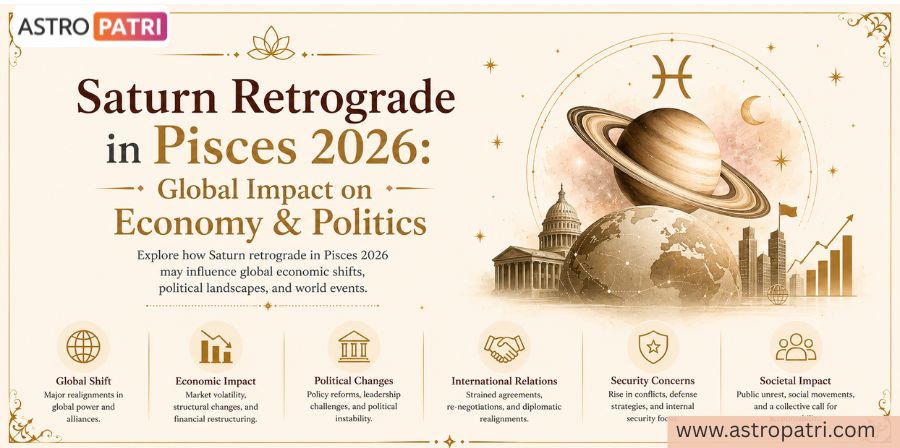
Saturn will turn retrograde in Pisces on 27 July 2026, marking an important planetary event in Vedic astrology that is traditionally linked with reflection, accountability, and long-term planning.
Rather than signalling sudden changes, Saturn’s retrograde is believed to encourage governments, businesses, institutions, and individuals to review unfinished work, strengthen existing systems, and make more thoughtful decisions before moving forward.
Known as the planet of karma, discipline, justice, responsibility, and perseverance, Saturn rarely rewards shortcuts. When it appears to move backwards, astrologers interpret this phase as an opportunity to reassess what has already been built instead of chasing rapid expansion.
Because this retrograde takes place in Pisces, a sign connected with compassion, healing, water, spirituality, and public welfare, discussions around healthcare, environmental sustainability, social support, and institutional reforms may become more prominent from an astrological perspective.
While astrology cannot predict specific world events, many astrologers view major planetary movements as indicators of broader themes that could shape public discussions and long-term priorities. Here’s what Saturn’s retrograde in Pisces may signify for the world according to Vedic astrology.
| Topic | What Saturn Retrograde Symbolises |
| Global Economy | Financial discipline, policy reviews and sustainable growth |
| Governments | Greater accountability, administrative reforms and long-term planning |
| Business & Industry | Improving existing operations instead of rapid expansion |
| Employment | Labour reforms, workforce planning and skill development |
| Healthcare | Focus on public health, mental well-being and institutional efficiency |
| Climate & Water | Water conservation, environmental planning and disaster preparedness |
| Education | Academic reforms, research and improving quality standards |
| Society & Spirituality | Compassion, self-reflection, charity and responsible living |
Saturn turning retrograde is one of the most significant planetary movements in Vedic astrology because it shifts the focus from external progress to internal review. Rather than encouraging rapid expansion or major new beginnings, this phase is traditionally associated with reflection, accountability, and strengthening long-term foundations.
Saturn represents karma, discipline, justice, responsibility, law, governance, and perseverance. When it appears to move backwards, astrologers believe it encourages people, organisations, and governments to pause and evaluate existing systems instead of rushing into new ones.
Since Saturn will be retrograde in Pisces, a sign connected with compassion, healing, spirituality, water resources, and emotional awareness, the transit may bring greater attention to healthcare, public welfare, environmental concerns, and humanitarian initiatives. From a Vedic astrology perspective, this is a period for thoughtful planning, correcting past mistakes, and building sustainable progress.
From an astrological perspective, Saturn retrograde often encourages caution rather than aggressive expansion. Governments, financial institutions, and businesses may prefer reviewing existing economic policies instead of introducing large-scale reforms.
Long-term investments, infrastructure planning, and fiscal discipline could receive greater attention, while organisations may focus on improving efficiency, reducing unnecessary expenditure, and strengthening operational stability.
Although markets are influenced by many economic and geopolitical factors, Saturn’s retrograde is traditionally associated with measured growth, responsible financial planning, and sustainable development rather than quick gains.
Saturn governs administration, justice, responsibility, and institutional order in Vedic astrology. During its retrograde phase, governments may place greater emphasis on reviewing existing policies, strengthening governance, and improving transparency.
Administrative reforms, public accountability, and discussions around long-term development plans could become more prominent. Rather than introducing sweeping changes, authorities may focus on refining existing programmes and addressing structural challenges.
This transit symbolically encourages responsible leadership, balanced decision-making, and stronger institutional foundations.
Businesses often benefit from reviewing strategies before expanding, and Saturn retrograde reflects a similar theme in astrology.
Industries connected with manufacturing, construction, logistics, engineering, mining, infrastructure, compliance, auditing, and risk management may prioritise improving existing operations over launching ambitious new projects.
Companies could focus on productivity, operational efficiency, cost management, and long-term planning. Businesses that invest in sustainable growth rather than rapid expansion may find this period especially valuable for strengthening their foundations.
Saturn is regarded as the natural significator of labour, discipline, and professional responsibility.
This retrograde may encourage discussions around employment policies, workplace regulations, employee welfare, and skill development. Organisations may review workforce planning, productivity, and long-term staffing strategies, while employees could experience greater responsibilities and expectations.
Although progress may feel gradual, consistent effort, patience, and professional discipline are traditionally rewarded during Saturn’s influence.
Pisces is closely associated with healing, compassion, and service, making healthcare and public welfare important themes during this transit.
From an astrological perspective, greater attention may be given to strengthening healthcare systems, improving mental well-being, expanding social support programmes, and enhancing institutional efficiency.
Charitable organisations, humanitarian initiatives, and community welfare projects may also receive renewed focus as governments and institutions review long-term public service strategies.
Because Pisces is a water sign, many Vedic astrologers associate Saturn’s retrograde here with environmental awareness and responsible resource management.
This period may symbolically highlight discussions around water conservation, flood preparedness, sustainable development, climate resilience, and environmental protection. Governments and organisations could place greater emphasis on strengthening long-term policies related to natural resources and ecological sustainability.
Educational institutions and research organisations may use this period to improve quality rather than expand rapidly.
Academic policy reviews, curriculum improvements, scientific research, regulatory compliance, and institutional planning could become important areas of focus. Students may also benefit from revising concepts, strengthening fundamentals, and developing practical knowledge instead of rushing through new topics.
Beyond material matters, Saturn retrograde encourages personal growth through patience, humility, and responsibility.
Pisces naturally represents spirituality, compassion, meditation, and emotional healing. Together, these energies may inspire people to simplify their lives, reflect on personal responsibilities, practise charity, and develop greater emotional maturity.
Many astrologers consider this a favourable period for meditation, self-discipline, volunteer work, and reconnecting with values that support long-term inner growth.
| Area | Possible Astrological Influence |
| Economy | Long-term planning and financial discipline |
| Governance | Accountability and policy reviews |
| Business | Operational improvements and sustainable growth |
| Employment | Greater responsibility and workforce planning |
| Healthcare | Focus on public welfare and mental health |
| Environment | Water conservation and climate resilience |
| Education | Quality improvement and research |
| Spirituality | Reflection, compassion and self-discipline |
While Saturn retrograde is often associated with delays, its deeper purpose is to encourage better preparation and stronger foundations.
You can make the most of this transit by:
Saturn turning retrograde in Pisces on 27 July 2026 marks a period of reflection rather than rapid change. According to Vedic astrology, this transit encourages governments, businesses, and individuals to review existing systems, improve accountability, and strengthen long-term foundations before pursuing new opportunities.
While astrology cannot predict specific global events, Saturn’s retrograde is traditionally associated with careful planning, responsible leadership, sustainable growth, and personal discipline. By approaching this phase with patience, transparency, and practical thinking, it is possible to use Saturn’s lessons to build stronger foundations for the future.
What does Saturn turning retrograde mean in Vedic astrology?
Saturn turning retrograde is traditionally associated with reviewing long-term plans, strengthening discipline, correcting past mistakes, and taking greater responsibility rather than pursuing rapid expansion.
When will Saturn turn retrograde in 2026?
According to Vedic astrology, Saturn will turn retrograde in Pisces on 27 July 2026.
Is Saturn retrograde considered good or bad?
Saturn retrograde is neither entirely positive nor negative. It is generally viewed as a period for reflection, accountability, and improving long-term stability through careful planning.
How could Saturn retrograde affect the global economy?
From an astrological perspective, Saturn retrograde may encourage greater financial discipline, policy reviews, infrastructure planning, and sustainable economic strategies instead of aggressive growth.
Which sectors may receive greater attention during Saturn retrograde?
Astrologers often associate this transit with governance, infrastructure, labour, healthcare, environmental management, education, public welfare, and spirituality.
How can individuals prepare for Saturn retrograde?
Review your long-term goals, complete unfinished work, strengthen financial planning, remain disciplined, avoid rushed decisions, and focus on consistent effort and personal growth.
Instant Report Based on Our Proprietary Framework, Developed by Experts