-
 Translate
- Astropatri Values
- My Account
Translate

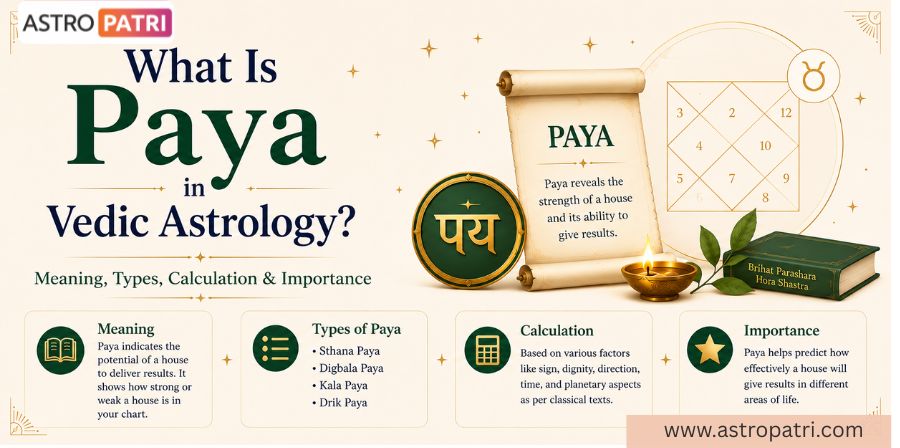
Paya in Vedic astrology is a traditional method that classifies a person’s birth into one of four categories: Swarna (Gold), Rajat (Silver), Tamra (Copper), or Loha (Iron). This classification is based on the Moon’s Nakshatra at the time of birth.
Paya offers a broad indication of a person’s prosperity, health, career, relationships, and overall life journey. However, it does not determine your destiny on its own. Astrologers always analyse Paya along with the complete birth chart, planetary yogas, dashas, and transits before making predictions.
If you’ve recently heard terms like Swarna Paya, Loha Paya, or Janma Paya, you’re not alone. These terms are often mentioned during a child’s birth, naming ceremony, or while preparing a horoscope. Yet, many people are unsure about what they actually mean or why they matter.
For centuries, Paya has been part of traditional Vedic astrology. It gives astrologers an overall idea of a person’s life path and the nature of opportunities and challenges they may encounter. Rather than predicting specific events, it offers a broad picture of how different areas of life may unfold.
It is also important to remember that Paya is only one part of horoscope analysis. Even someone with Loha Paya can achieve remarkable success if the birth chart contains powerful Raj Yogas or favourable planetary periods. Likewise, a person with Swarna Paya may still experience obstacles if important planets are weak or afflicted.
| Particular | Details |
| Sanskrit Name | Janma Paya |
| Meaning | Foundation or quality of life at birth |
| Calculated From | Moon’s Nakshatra |
| Total Types | Four |
| Types | Swarna, Rajat, Tamra and Loha |
| Used In | Birth chart analysis, Panchang and traditional astrology |
| Indicates | General life tendencies, prosperity, health and overall progress |
The Sanskrit word Paya means foundation, base, or support. In Vedic astrology, it refers to the overall quality of life indicated at the time of birth.
Ancient astrologers introduced this concept to gain a quick understanding of a person’s life journey before examining the complete horoscope. It acts as a broad indicator rather than a tool for making detailed predictions.
Paya can provide insights into several important aspects of life, including:
Its purpose is to offer a general direction, not a fixed outcome. The complete birth chart always remains the foundation of accurate astrological analysis.
If you’re trying to understand your Paya, the first thing to know is how it is calculated.
Paya is determined from the Moon’s Nakshatra at the exact time of birth. After identifying the birth Nakshatra, astrologers apply traditional Vedic astrology principles to classify the native into one of the four Payas: Swarna, Rajat, Tamra, or Loha.
The Moon plays a central role in this calculation because, in Vedic astrology, it represents the mind, emotions, instincts, and day-to-day experiences. Its position at the time of birth is believed to reveal how a person may experience opportunities, challenges, and important phases of life.
You can find online tools that calculate Paya within seconds. However, the result is only a starting point. The actual significance of your Paya can be understood only after examining your complete birth chart, including the Ascendant (Lagna), planetary positions, yogas, dashas, and divisional charts.
This is why two people with the same Paya can have completely different life journeys. The overall strength of the horoscope always carries greater importance than Paya alone.
Although modern astrology uses advanced software and detailed horoscope analysis, Paya continues to be an important part of traditional Vedic astrology.
Many astrologers still include it while preparing a birth chart because it offers a quick overview of the native’s life path. Families also remain curious to know whether a newborn has Swarna, Rajat, Tamra, or Loha Paya, making it a common topic during birth-related consultations.
Paya is frequently discussed during:
Today, most astrologers treat Paya as a supporting indicator rather than the sole basis for predictions. When combined with a detailed horoscope, it helps create a more complete understanding of a person’s potential and life journey.
Every person is assigned one of four types of Paya at birth. Each type is believed to reflect a different pattern of opportunities, responsibilities, and life experiences. Let’s understand what each Paya signifies.
Swarna Paya is traditionally regarded as the most auspicious among the four. It is often associated with prosperity, recognition, confidence, and steady growth. People born with Swarna Paya are believed to receive favourable opportunities throughout life, although success still depends on their efforts and planetary combinations.
People with Swarna Paya often succeed through their skills, determination, and ability to make the most of opportunities.
Rajat Paya is also considered favourable. It represents balance, stability, and gradual progress. Instead of sudden success, people with Rajat Paya usually achieve their goals through patience, discipline, and consistent effort.
Life may move at a steady pace, allowing them to build lasting relationships, financial security, and a stable career.
For many natives, Rajat Paya brings long-term stability rather than quick success.
Tamra Paya represents a balanced mix of opportunities and challenges. Progress is usually earned through persistence rather than luck. Life may include periods of struggle, but those experiences often help build resilience and practical wisdom.
People with Tamra Paya frequently discover that their biggest achievements come after overcoming setbacks.
Although progress may take time, consistent effort often produces rewarding results.
Loha Paya is traditionally considered the most challenging of the four, but it is also the most misunderstood.
Many people assume that Loha Paya guarantees an unhappy life. In reality, it simply suggests that success may come after greater effort, patience, and responsibility.
A strong horoscope can significantly reduce or even completely neutralise these challenges.
Many highly successful people have Loha Paya because determination, discipline, and favourable planetary combinations often outweigh its traditional limitations.
| Paya | Traditional Significance | Life Pattern |
| Swarna Paya | Most favourable | Prosperity, recognition, steady progress |
| Rajat Paya | Favourable | Stability, balance, gradual success |
| Tamra Paya | Mixed | Growth through effort and experience |
| Loha Paya | Comparatively challenging | Success through patience and perseverance |
The simple answer is no.
Paya offers a general indication of life’s direction, but it does not determine every event or outcome.
Your destiny is shaped by many important astrological factors, including:
Think of Paya as one piece of a much larger puzzle. It helps astrologers understand the overall picture, but the complete horoscope reveals how that picture develops over time.
Paya and Nakshatras are closely connected because Paya is determined from the Moon’s Nakshatra at the time of birth. Without knowing the birth Nakshatra, it is not possible to identify a person’s Janma Paya.
In Vedic astrology, the Moon represents the mind, emotions, habits, and daily experiences. Its Nakshatra reveals a person’s natural qualities, while Paya provides a broader indication of how those qualities may unfold throughout life.
For example, two people may be born under the same Nakshatra but experience different life journeys because their Ascendant, planetary combinations, dashas, and yogas are different. This is why Paya should always be interpreted as one part of a complete horoscope rather than a standalone prediction.
Many misconceptions surround Paya, especially on social media and informal astrology discussions. Understanding the facts can help avoid unnecessary fear or unrealistic expectations.
Myth 1: Swarna Paya Guarantees a Successful Life
Not necessarily.
Swarna Paya is considered favourable, but success still depends on your karma, planetary strengths, dashas, and personal efforts. A weak horoscope can reduce its positive effects.
Myth 2: Loha Paya Brings Only Difficulties
This is one of the biggest misconceptions in Vedic astrology.
Loha Paya simply suggests that success may require greater patience and perseverance. Many successful people have Loha Paya because their birth charts contain strong Raj Yogas or supportive planetary combinations.
Myth 3: Paya Alone Can Predict the Future
No.
Experienced astrologers never rely on Paya alone. Accurate predictions always require a detailed analysis of the entire birth chart.
Myth 4: People With the Same Paya Will Have Similar Lives
Not true.
Even if two people share the same Paya, their lives can be completely different because every horoscope has unique planetary placements, yogas, and dasha periods.
Paya is one of the oldest and most respected concepts in Vedic astrology. Determined from the Moon’s Nakshatra at birth, it provides a broad indication of a person’s life journey, including prosperity, health, relationships, career, and overall progress.
Instead of seeing Paya as a prediction of good or bad fortune, think of it as an ancient guide that helps astrologers understand the overall direction of life. With the right efforts, favourable planetary periods, and informed decisions, every individual has the potential to achieve success, regardless of their Paya.
If you want to know your Paya, Janma Nakshatra, Moon sign, and detailed birth chart analysis, consult experienced Vedic astrologers at Astropatri for personalised guidance based on your complete horoscope.
1. What is Paya in Vedic astrology?
Paya is a traditional Vedic astrology concept that classifies a person’s birth into Swarna, Rajat, Tamra, or Loha Paya based on the Moon’s Nakshatra. It offers a broad indication of prosperity, health, career, and overall life direction.
2. How can I know my Paya?
Your Paya is calculated using your date of birth, exact time of birth, place of birth, and the Moon’s Nakshatra. An astrologer or a reliable Janma Kundli calculator can determine it accurately.
3. Which Paya is considered the most auspicious?
Traditionally, Swarna Paya is considered the most favourable because it is associated with prosperity, recognition, and steady progress. However, the complete birth chart always has a greater influence on a person’s destiny.
4. Is Loha Paya considered unlucky?
No. Loha Paya does not mean lifelong struggles or bad luck. It simply indicates that success may come through patience, discipline, and consistent effort. Strong planetary combinations can significantly reduce its challenges.
5. Does Paya affect marriage, career, and wealth?
Paya provides only a general indication of life’s direction. Detailed predictions about marriage, career, finances, health, or relationships always depend on the complete birth chart, planetary yogas, dashas, and current transits.
Instant Report Based on Our Proprietary Framework, Developed by Experts