
Generate Free Online Kundli
-
 Translate
- Astropatri Values
- My Account
Translate

Jyeshtha is the 18th Nakshatra in Vedic astrology, spanning 16°40′ to 30°00′ Scorpio. Ruled by Mercury (Budha) and associated with Indra, the king of the Devas, Jyeshtha represents seniority, intelligence, responsibility, protection and the ability to handle difficult situations.
The word Jyeshtha means eldest, senior-most or foremost. This gives the Nakshatra a strong sense of responsibility. People influenced by Jyeshtha may often feel that they have to know more, manage more or step forward when others hesitate.
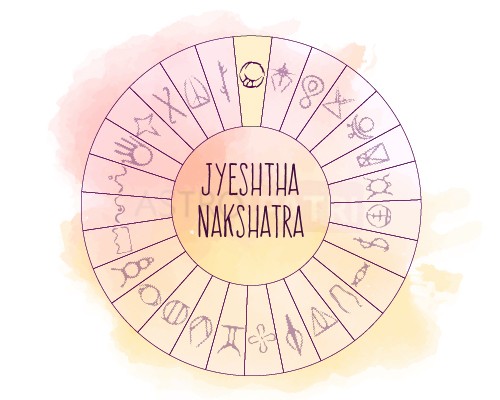
Its symbols include the umbrella, protective amulet and earring. The umbrella suggests shelter. The amulet suggests protection. The earring represents distinction and status. Together, they reflect the Nakshatra’s connection with responsibility and seniority.
Mercury gives Jyeshtha a strategic mind, while Scorpio adds depth, privacy and emotional intensity. This combination can be valuable in situations involving research, confidential information, complex decisions and crisis management.
The challenge comes when competence turns into pride or caution turns into suspicion. Jyeshtha becomes stronger when it can take responsibility without feeling that everything must remain under its control.
The exact results of Jyeshtha depend on the planet placed in it, its house, Rashi, aspects, conjunctions, Pada, Navamsa and Dasha. The Nakshatra should always be interpreted as part of the complete Kundli.
 Jyeshtha Nakshatra: Quick Facts
What Is Jyeshtha Nakshatra?
Indra and the Symbolism of the Umbrella
Jyeshtha Nakshatra Personality Traits
Emotional Nature of Jyeshtha Nakshatra
Jyeshtha Nakshatra Spiritual Significance
Jyeshtha Nakshatra Padas
Jyeshtha Nakshatra Career and Profession
Jyeshtha Nakshatra and Money
Jyeshtha Nakshatra in Love and Marriage
Jyeshtha Nakshatra Compatibility
Jyeshtha Nakshatra and Family Life
Is Jyeshtha Nakshatra a Gandamoola Nakshatra?
Jyeshtha Nakshatra Health Insights
Is Jyeshtha Nakshatra Good or Bad?
What Is the Dark Side of Jyeshtha Nakshatra?
Moon in Jyeshtha Nakshatra
Jyeshtha Nakshatra and Spiritual Growth
Jyeshtha Nakshatra Remedies
Astropatri Expert Insights on Jyeshtha Nakshatra
Final Thought
Frequently Asked Questions
| Attribute | Details |
| Nakshatra Number | 18th |
| Name | Jyeshtha |
| Meaning | Eldest, Senior-most, Foremost |
| Degree Range | 16°40′ to 30°00′ Scorpio |
| Rashi | Scorpio |
| Nakshatra Lord | Mercury |
| Sign Lord | Mars |
| Deity | Indra |
| Symbol | Umbrella, Amulet, Earring |
| Nature | Tikshna, Sharp |
| Gana | Rakshasa |
| Guna | Sattvic |
| Nadi | Adi |
| Yoni | Deer |
| Purushartha | Artha |
| Element | Air |
| Padas | 4 |
| Traditional Name Sounds | No, Ya, Yi, Yu |
| Astronomical Association | Antares |
Jyeshtha is associated with seniority and responsibility.
This does not necessarily mean being the eldest child or holding a formal position. It can simply show up as a strong instinct to take charge when something needs to be handled.
The native may become the person others approach for advice, difficult decisions or sensitive matters.
Scorpio gives the Nakshatra a private and observant nature. Mercury adds reasoning and communication. As a result, Jyeshtha can be good at noticing risks, reading situations and keeping important information discreet.
This ability is useful when judgement matters.
However, being alert to problems can also create unnecessary suspicion. Jyeshtha needs evidence before concluding.
Indra is the presiding deity of Jyeshtha and represents authority, strength and protection.
The umbrella is an especially fitting symbol. Its purpose is simple: it provides shelter when conditions become difficult.
Jyeshtha can express this through taking responsibility for family members, leading teams, managing crises or protecting information entrusted to it.
The deeper point is that authority creates obligations.
A person in a senior position has greater influence, but also greater responsibility for how that influence is used.
Jyeshtha’s higher expression is therefore protective leadership rather than domination.
Jyeshtha natives can come across as composed, capable and difficult to read. They may prefer to observe before revealing their position.
They can also be witty and surprisingly light-hearted with people they trust.
Sharp and Analytical
Mercury supports logical thinking, communication and the ability to break complex situations into manageable parts.
Resourceful
They can often find a practical solution when circumstances are complicated.
Protective
They may feel responsible for people they care about and are often willing to step in during difficult periods.
Discreet
They usually understand that not every piece of information needs to be shared.
Resilient
Scorpio’s depth can help them stay focused during pressure or uncertainty.
Strategic
They may prefer planning several steps ahead instead of acting impulsively.
Ambitious
A strong desire to become capable and respected can motivate them to develop expertise.
Mature in Difficult Situations
They may become more effective with experience because each challenge adds to their judgement.
Pride
Competence can sometimes turn into the assumption that their way is the only correct way.
Suspicion
An observant mind can become overly cautious when trust is weak.
Emotional Withdrawal
They may keep difficult feelings private instead of discussing them.
Sharp Reactions
Criticism or betrayal can trigger a stronger response than intended.
Over-Responsibility
They may take on tasks that could easily be shared with others.
Difficulty Forgiving
A serious breach of trust can remain in memory for a long time.
The goal is not to become less strong.
It is to become more flexible about how strength is expressed.
Jyeshtha often processes emotions privately.
When something goes wrong, the native may first try to understand the situation and fix it rather than explain how deeply it affected them.
That can make them appear calm even when they are under pressure.
In close relationships, this can become a problem if silence is mistaken for emotional stability.
Jyeshtha benefits from speaking directly about hurt, disappointment and expectations rather than withdrawing and waiting for others to understand.
Trust also matters greatly. Once it is established, the native can become deeply committed. When it is broken, rebuilding it may take time.
Jyeshtha’s spiritual lesson centres on the responsible use of power.
Its first instinct may be to become strong enough to protect itself from uncertainty.
With maturity, that goal can change.
The native begins to understand that real strength includes humility, restraint and the ability to trust others.
Indra’s symbolism makes this distinction important. Leadership can be used to create security, or it can become a way to dominate.
Jyeshtha grows when influence is used for protection, guidance and service rather than personal superiority.
Jyeshtha has four Padas of 3°20′ each. All four lie in Scorpio, while their Navamsas are Sagittarius, Capricorn, Aquarius and Pisces.
Degree: 16°40′–20°00′ Scorpio
Navamsa: Sagittarius
Pada Lord: Jupiter
This Pada adds learning, ethics and a broader perspective to Jyeshtha.
The native may be drawn toward subjects where judgement and knowledge matter.
Career: Law, teaching, consulting, leadership, administration and advisory roles.
Relationships: Respect and honesty are important. Differences in beliefs need room for discussion.
Degree: 20°00′–23°20′ Scorpio
Navamsa: Capricorn
Pada Lord: Saturn
This Pada strengthens discipline and career ambition.
The native may prefer structured environments where responsibility and experience lead to greater authority.
Career: Management, government, finance, operations and corporate leadership.
Relationships: Dependable and serious, but emotional expression should not be replaced by duty.
Degree: 23°20′–26°40′ Scorpio
Navamsa: Aquarius
Pada Lord: Saturn
This Pada gives a more analytical and unconventional approach.
The native may enjoy solving systemic problems and questioning established methods.
Career: Technology, research, analytics, strategy, consulting and policy-related work.
Relationships: Friendship and intellectual respect can be important.
Degree: 26°40′–30°00′ Scorpio
Navamsa: Pisces
Pada Lord: Jupiter
This Pada softens Jyeshtha with greater intuition and empathy.
The native may be interested in psychology, spirituality or subjects that require emotional understanding.
Career: Counselling, psychology, research, writing, healing-related and spiritual fields.
Relationships: Deep emotional bonds matter, but trust should not be confused with constant reassurance.
Jyeshtha can work well in professions where discretion, analysis, responsibility and judgement are important.
The native may be especially effective when a role involves confidential information, complicated decisions or situations that require composure.
Mercury supports analysis and communication. Scorpio encourages depth and persistence.
This can make Jyeshtha particularly useful in careers where experience becomes a source of authority.
The main professional mistake is choosing a position mainly for status. Responsibility is more rewarding when the work itself is meaningful.
Financial security can matter greatly to Jyeshtha because independence provides a sense of control over uncertain circumstances.
The native may prefer to build resources steadily rather than depend entirely on others.
Strategic Planning
They may be willing to research before making major financial decisions.
Long-Term Thinking
A clear financial objective can keep them focused for years.
Risk Awareness
Their ability to notice hidden complications can be useful in financial planning.
Earning Through Expertise
As professional experience grows, specialised knowledge can create stronger income opportunities.
Status-driven spending can become a problem when financial success is used to prove personal worth.
There can also be a tendency to keep supporting someone financially because of loyalty.
Jyeshtha benefits from separating trust in a person from trust in a financial decision.
Jyeshtha tends to take close relationships seriously.
The native may not open up immediately, but once trust develops, they can become deeply committed and protective.
They often prefer relationships that feel private, secure and emotionally genuine.
They may value a partner who respects their vulnerabilities and keeps personal matters confidential.
Consistency is usually more attractive to them than superficial excitement.
Possessiveness can appear when the native becomes afraid of losing someone.
Another issue is silence. Jyeshtha may withdraw after being hurt instead of explaining what happened.
A healthier approach is to communicate directly and allow the partner to respond.
Marriage outcomes should be judged from the complete Kundli, including the 7th house, 7th lord, Venus, Jupiter, Navamsa and relevant Dashas.
Traditional Nakshatra matching considers factors such as Gana, Yoni, Nadi and other Koota factors.
Jyeshtha is commonly classified as Rakshasa Gana, Deer Yoni and Adi Nadi.
These classifications are only one part of compatibility.
For Jyeshtha, practical relationship compatibility may also depend on how two people handle:
A complete Kundli comparison provides a broader picture than matching Nakshatra names alone.
Jyeshtha natives may become the person their family relies on during difficult situations.
They can take financial, practical or emotional responsibilities seriously.
That role can strengthen family bonds, but it can also become exhausting when the native assumes that every problem is theirs to solve.
Sharing responsibility is important.
Being the reliable person in the family does not mean being responsible for everything.
Yes. Jyeshtha is traditionally counted among the six Gandamoola Nakshatras.
This classification should not be interpreted as a prediction of misfortune.
Different traditions approach Gandamoola and related concepts in different ways. For an individual assessment, the complete Kundli and the family’s traditional practices should be considered rather than judging a person from the Nakshatra alone.
Traditional astrology associates Jyeshtha with specific body regions and constitutional themes. These classifications are symbolic and can vary across traditions.
They should not be treated as medical predictions.
From a practical perspective, Jyeshtha benefits from adequate rest and healthy ways of handling prolonged responsibility.
People who remain mentally alert for long periods can also benefit from regular physical activity, sufficient sleep and time away from demanding environments.
Any persistent symptom should be evaluated by a qualified healthcare professional.
Jyeshtha is neither inherently good nor bad.
Its strengths include intelligence, resilience, discretion, strategic thinking and leadership.
Its challenges can include pride, suspicion, emotional withdrawal and over-control.
The outcome depends on how these qualities interact with the rest of the horoscope.
Jyeshtha is strongest when authority is balanced with humility.
The difficult side of Jyeshtha often appears when the native feels that trusting others is unsafe.
This may lead to excessive control, secrecy or keeping emotional distance.
Mercury can make the native strategically clever. Without ethical boundaries, that intelligence can become manipulation.
Scorpio can also hold onto past betrayals longer than necessary.
The healthier response is to assess people by their present actions instead of allowing one past experience to define every future relationship.
When the Moon is placed in Jyeshtha Nakshatra, traditional astrology associates the mind with responsibility, observation, privacy and emotional depth.
The person may quickly notice changes in people or situations and can feel compelled to handle problems before others do.
They may also be selective about emotional intimacy.
The challenge is keeping analysis from replacing emotional expression.
The exact results depend on the Moon’s house, Rashi, aspects, conjunctions, Pada, Navamsa and Dasha.
Jyeshtha’s spiritual development involves changing the meaning of strength.
Early on, strength may mean being independent and difficult to hurt.
With maturity, strength becomes the ability to remain open without becoming careless.
The native learns to protect without controlling, lead without intimidating and accept help without seeing it as weakness.
This shift turns authority into wisdom.
Traditional remedies can be approached as practices for developing humility, clarity and emotional balance.
Prayer or remembrance of Indra can help reflect on courage, leadership and the responsible use of authority.
Those following traditional Vedic practices may chant:
Om Budhaya Namah
Helping elders, juniors or people facing practical difficulties reflects the protective side of Jyeshtha.
Listen to different viewpoints and allow others to contribute instead of assuming you must handle everything.
Address hurt or disagreement before it turns into withdrawal or resentment.
Meditation, prayer, study or journaling can help organise thoughts and reduce emotional overload.
The final interpretation of Jyeshtha depends on the planet occupying it, house placement, Rashi, aspects, conjunctions, Pada, Navamsa and Dasha.
Jyeshtha carries the responsibility of the eldest.
Its strength lies in experience, judgement and the ability to remain composed when circumstances become difficult. But seniority is not about always being in control.
It is about knowing when to lead, when to listen and when to let someone else carry the weight.
Protect without controlling. Lead without overpowering. Stay strong without shutting people out.
That is when Jyeshtha turns authority into wisdom.
Important Note
Nakshatra interpretations describe traditional tendencies, not fixed outcomes. Jyeshtha can express differently depending on planetary placement, house, Rashi, aspects, conjunctions, Pada, Navamsa and Dasha.
Marriage, career and financial matters should be assessed through the complete Kundli. Traditional health associations are symbolic and should not replace professional medical advice.
Jyeshtha is the 18th Nakshatra in Vedic astrology, spanning 16°40′ to 30°00′ Scorpio. Ruled by Mercury and associated with Indra, it represents seniority, responsibility, intelligence, protection and leadership.
The presiding deity is Indra, traditionally associated with authority, courage and protection. His symbolism gives Jyeshtha a strong connection with responsibility and leadership.
Jyeshtha is associated with an umbrella, protective amulet and earring. These symbols represent shelter, protection, distinction and seniority.
Jyeshtha natives are traditionally associated with intelligence, strategic thinking, discretion, resilience, protectiveness and leadership. Challenges can include pride, suspicion, emotional withdrawal and controlling behaviour.
Traditional compatibility considers Gana, Yoni, Nadi and other Koota factors. Jyeshtha is commonly classified as Rakshasa Gana, Deer Yoni and Adi Nadi. Complete Kundli matching provides a broader assessment.
The four Jyeshtha padas fall in Sagittarius, Capricorn, Aquarius and Pisces Navamsas. They add different qualities related to knowledge, discipline, systems thinking and intuition.
The traditional starting sounds for Jyeshtha are No, Ya, Yi and Yu, corresponding to its four padas.
Yes. Jyeshtha is traditionally included among the six Gandamoola Nakshatras. This classification should not be treated as a prediction of misfortune. Individual interpretation requires the complete Kundli.
Jyeshtha’s spiritual lesson is to use strength responsibly. It encourages the native to protect without dominating, lead without overpowering and develop humility alongside authority.
Instant Report Based on Our Proprietary Framework, Developed by Experts