
Generate Free Online Kundli
-
 Translate
- Astropatri Values
- My Account
Translate

Purva Bhadrapada is the 25th Nakshatra in Vedic astrology, spanning 20°00′ Aquarius to 3°20′ Pisces. Ruled by Jupiter (Brihaspati) and associated with the deity Aja Ekapada, this Nakshatra represents intensity, strong convictions, philosophical inquiry and the possibility of profound personal transformation.
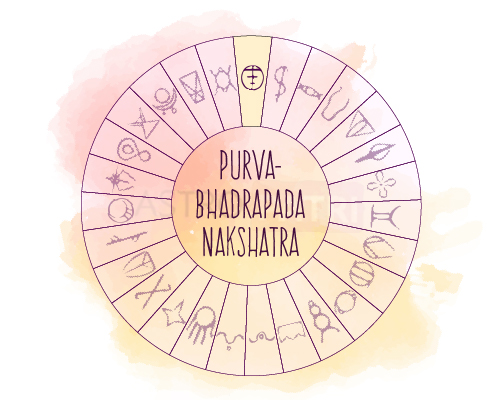
The name Purva Bhadrapada is commonly interpreted as the “former blessed feet” or “earlier auspicious one.” Its symbolism includes the front legs of a funeral cot, a sword and a two-faced figure. These images point towards transition, the separation of old attachments and the ability to look at life from different perspectives.
People influenced by Purva Bhadrapada are traditionally described as thoughtful, determined and drawn to questions that go beyond everyday concerns. They may want their work, relationships and personal choices to have a deeper purpose. At times, however, this intensity can turn into overthinking, rigid beliefs or emotional extremes.
Jupiter brings a philosophical and knowledge-seeking dimension to the Nakshatra, while its position across Aquarius and Pisces adds two distinct influences. Saturn rules the Aquarius portion, emphasising discipline and independent thought. Jupiter rules the Pisces portion, bringing greater attention to faith, intuition and inner meaning.
Understanding Purva Bhadrapada requires more than a list of personality traits. Its Pada, planetary placements, house position and Dasha all help explain how these qualities may appear in an individual birth chart.
 Purva Bhadrapada Nakshatra: Quick Facts
What Is Purva Bhadrapada Nakshatra?
Aja Ekapada and the Symbolism of Purva Bhadrapada
Purva Bhadrapada Nakshatra Personality Traits
Emotional Nature of Purva Bhadrapada
Purva Bhadrapada Nakshatra Padas
Purva Bhadrapada Nakshatra Career and Profession
Purva Bhadrapada Nakshatra and Money
Purva Bhadrapada Nakshatra in Love and Marriage
Purva Bhadrapada Nakshatra Compatibility
Purva Bhadrapada Nakshatra and Family Life
Purva Bhadrapada Nakshatra Health Insights
Is Purva Bhadrapada Nakshatra Good or Bad?
What Is the Dark Side of Purva Bhadrapada Nakshatra?
Moon in Purva Bhadrapada Nakshatra
Purva Bhadrapada Nakshatra and Vimshottari Dasha
Purva Bhadrapada Nakshatra Remedies
Astropatri Expert Insights
Final Thought
Frequently Asked Questions
Purva Bhadrapada Nakshatra: Quick Facts
What Is Purva Bhadrapada Nakshatra?
Aja Ekapada and the Symbolism of Purva Bhadrapada
Purva Bhadrapada Nakshatra Personality Traits
Emotional Nature of Purva Bhadrapada
Purva Bhadrapada Nakshatra Padas
Purva Bhadrapada Nakshatra Career and Profession
Purva Bhadrapada Nakshatra and Money
Purva Bhadrapada Nakshatra in Love and Marriage
Purva Bhadrapada Nakshatra Compatibility
Purva Bhadrapada Nakshatra and Family Life
Purva Bhadrapada Nakshatra Health Insights
Is Purva Bhadrapada Nakshatra Good or Bad?
What Is the Dark Side of Purva Bhadrapada Nakshatra?
Moon in Purva Bhadrapada Nakshatra
Purva Bhadrapada Nakshatra and Vimshottari Dasha
Purva Bhadrapada Nakshatra Remedies
Astropatri Expert Insights
Final Thought
Frequently Asked Questions
| Attribute | Details |
| Nakshatra Number | 25th of 27 |
| Meaning | Former blessed feet or earlier auspicious one |
| Zodiac Range | 20°00′ Aquarius–3°20′ Pisces |
| Nakshatra Lord | Jupiter |
| Sign Lords | Saturn in Aquarius; Jupiter in Pisces |
| Presiding Deity | Aja Ekapada |
| Symbols | Front legs of a funeral cot, sword and two-faced figure |
| Gana | Manushya |
| Yoni | Lion |
| Nadi | Adi |
| Padas | Four |
| Pada Navamsas | Aries, Taurus, Gemini and Cancer |
| Traditional Name Sounds | Se, So, Da, Di |
| Core Themes | Conviction, transformation, knowledge and spiritual inquiry |
Purva Bhadrapada is associated with the desire to look beyond appearances and understand what gives life its deeper meaning.
People with a strong Purva Bhadrapada influence may question established beliefs, explore philosophical ideas or become interested in subjects that require sustained thought. They are often drawn to work that challenges them intellectually rather than simply offering routine or recognition.
Jupiter, its ruling planet, represents knowledge, wisdom and the search for understanding in traditional Jyotish. This influence can support teaching, research, writing, philosophy and spiritual study.
However, the Nakshatra also has an intense side. When someone becomes deeply attached to an idea, they may find it difficult to consider another perspective. Their determination can help them pursue ambitious goals, but it can also make compromise difficult.
The central lesson of Purva Bhadrapada is to combine conviction with discernment. Strong beliefs become more useful when they leave room for learning.
Aja Ekapada is the presiding deity of Purva Bhadrapada. This distinctive Vedic figure is associated with powerful, fiery imagery and is linked in traditional interpretations with Rudra.
The deity’s symbolism gives Purva Bhadrapada a serious and transformative character. It suggests the ability to face difficult experiences, question old assumptions and move towards a new understanding.
The Nakshatra’s other symbols deepen this interpretation.
The front legs of a funeral cot represent transition and the temporary nature of worldly attachments. This symbolism does not predict death. Instead, it can be understood as a reminder that identities, circumstances and priorities change over time.
The sword represents separation and decisive action. In a personal context, this can mean recognising when an old habit, limiting belief or unhelpful pattern needs to end.
The two-faced figure represents duality and the ability to consider different directions. A person may experience tension between practical responsibilities and spiritual interests, or between the life they currently lead and the one they hope to create.
Together, these symbols describe a Nakshatra concerned with confronting contradictions and finding a more meaningful direction.
Purva Bhadrapada personalities are traditionally associated with depth, determination and a strong inner code. They may not feel satisfied with superficial explanations, especially when a subject matters to them.
Determined: Once they commit to a worthwhile goal, they can work towards it with considerable persistence.
Thoughtful: They often examine ideas carefully instead of accepting them without question.
Knowledge-seeking: Philosophy, spirituality, research and specialised subjects may hold their interest.
Principled: They may feel strongly about fairness, honesty and acting according to their beliefs.
Creative: Their ability to connect different ideas can support original thinking and problem-solving.
Resilient: Difficult experiences can encourage reflection and a change in priorities.
Persuasive: Jupiter’s influence can support communication, teaching and the ability to explain complex ideas.
The same intensity can create difficulties when it is not balanced.
Purva Bhadrapada may become too attached to a particular belief or expect others to share the same level of commitment. Strong determination can turn into stubbornness, while deep reflection can become unnecessary rumination.
Some individuals may also experience tension between idealism and practical reality. They may want meaningful work and relationships but feel disappointed when everyday life does not match their expectations.
Growth comes from remaining committed to personal values without assuming that there is only one correct way to live.
Purva Bhadrapada may experience emotions intensely, even when that intensity is not immediately visible to others.
A person may appear composed while privately thinking through a disagreement, a change in circumstances or an important decision. They often need time to understand what an experience means before discussing it openly.
In relationships, this depth can create loyalty and meaningful conversations. However, it can also lead to emotional distance when the person feels misunderstood.
The helpful distinction is between reflection and withdrawal. Taking time to process feelings can be healthy, but expecting others to understand unspoken concerns can create avoidable tension.
Emotional balance develops when deep thinking is supported by direct communication and realistic expectations.
Each Nakshatra has four Padas, or quarters, of 3°20′ each. Purva Bhadrapada’s four Padas fall in Aries, Taurus, Gemini and Cancer Navamsas, giving each quarter a different emphasis.
Degrees: 20°00′–23°20′ Aquarius
Navamsa: Aries
Traditional name sound: Se
The first Pada adds initiative, courage and a more action-oriented approach. These individuals may be quick to defend their beliefs and eager to turn ideas into action.
Leadership, research, entrepreneurship and work involving difficult decisions may appeal to them.
The challenge is acting before considering the consequences. Patience can help turn strong convictions into effective decisions.
Degrees: 23°20′–26°40′ Aquarius
Navamsa: Taurus
Traditional name sound: So
The second Pada brings a more practical and grounded expression. It can help translate ambitious ideas into steady work and tangible results.
These individuals may value financial stability, professional competence and the ability to build something lasting. They may also have an interest in art, design or other creative pursuits.
Their lesson is to balance material security with the deeper purpose that motivates them.
Degrees: 26°40′–30°00′ Aquarius
Navamsa: Gemini
Traditional name sound: Da
The third Pada emphasises communication, curiosity and intellectual exploration.
Writing, teaching, debate, research and analytical work may be attractive because they provide opportunities to examine ideas and share knowledge.
These individuals may enjoy considering opposing viewpoints, although strong personal beliefs can sometimes make discussions unnecessarily intense.
Their growth comes from using communication to understand others, not simply to prove a point.
Degrees: 0°00′–3°20′ Pisces
Navamsa: Cancer
Traditional name sound: Di
The fourth Pada adds sensitivity, intuition and a stronger interest in emotional or spiritual meaning. Its Pisces placement may encourage reflection on compassion, faith and the inner life.
These individuals may be drawn to creative work, teaching, spiritual study or activities that help others.
The challenge is maintaining healthy boundaries. Caring deeply about a person or cause does not mean taking responsibility for everything.
Purva Bhadrapada can suit careers that reward persistence, original thinking and the ability to examine complex subjects.
Potential fields include:
The common factor is a need to understand, improve or explain something meaningful.
For example, someone with this influence may enjoy researching a difficult subject, developing an original argument or teaching others what they have learned. Another person may channel the same determination into technology, business strategy or a creative profession.
These are traditional astrological possibilities, not fixed career predictions. The 10th house, its lord, relevant planetary placements and current Dasha should be considered before making an individual career assessment.
Purva Bhadrapada’s relationship with money may be shaped by the tension between practical security and personal purpose.
Some individuals may work hard to build financial independence but feel that wealth alone does not provide lasting satisfaction. Others may invest considerable time and resources in education, creative work or causes they believe in.
The main financial challenge is allowing strong convictions to replace careful planning.
A meaningful goal still needs a realistic budget. An exciting opportunity still requires an assessment of risk.
A clear savings plan, measured investment decisions and realistic financial priorities can help balance ambition with stability. Astrology should not replace professional financial advice or evidence-based investment decisions.
Purva Bhadrapada often seeks more than surface-level attraction. Intellectual connection, shared values and a sense of purpose may be important in a lasting relationship.
These individuals may value partners who are willing to discuss difficult questions and respect their personal convictions. They may be deeply committed when they believe a relationship has genuine meaning.
They can also bring thoughtfulness and loyalty to a partnership.
However, emotional intensity does not always make communication easier. Someone may expect a partner to understand their concerns without explaining them clearly.
Strong beliefs can become a source of conflict when neither person is willing to reconsider their position. Idealising a partner can also create disappointment when ordinary differences appear.
A healthy relationship requires more than shared philosophy. It needs trust, practical cooperation, emotional availability and respect for individual boundaries.
Purva Bhadrapada can build stronger partnerships by allowing room for disagreement without treating it as a threat to the relationship.
Traditional Kundli Matching considers factors such as Gana, Yoni, Nadi, the Moon signs and other elements of both birth charts. Purva Bhadrapada is traditionally classified as Manushya Gana, Lion Yoni and Adi Nadi.
These classifications contribute to traditional compatibility calculations, but they do not establish whether a marriage will succeed or fail.
A fuller assessment considers both partners’ Moon placements, seventh houses, relevant planetary influences and Navamsa charts. It should also account for communication, shared expectations and practical circumstances.
There is no single Nakshatra that guarantees the best match for every Purva Bhadrapada native. Compatibility is more meaningfully assessed through the complete Kundlis rather than one classification alone.
Purva Bhadrapada may bring strong opinions about family values, responsibilities and the kind of life a person wants to build.
Some individuals may respect tradition while questioning practices they consider unhelpful. Others may prefer a more reflective or unconventional approach to family life.
These differences do not necessarily indicate conflict. They become easier to manage when personal beliefs are expressed respectfully and family members are allowed to have different views.
The ability to listen is just as important as the ability to speak with conviction.
Traditional Jyotish assigns symbolic bodily associations to Nakshatras. These associations vary across traditions and should not be used to diagnose illness or predict a medical condition.
A Nakshatra placement cannot establish whether someone will develop a particular disease. For health concerns, seek assessment from a qualified healthcare professional.
General well-being is better supported by consistent sleep, balanced nutrition, physical activity and appropriate medical care.
Purva Bhadrapada is neither inherently good nor bad. Its traditional qualities can express differently depending on the complete birth chart.
Its strengths include persistence, intellectual depth, idealism and the ability to question established assumptions. Its challenges may include rigid beliefs, excessive introspection and difficulty accepting perspectives that differ from its own.
The purpose of understanding a Nakshatra is not to label a person. It is to explore tendencies that may be useful to recognise and develop.
The challenging side of Purva Bhadrapada can appear when intensity becomes an all-or-nothing approach.
A person may become so committed to an idea that changing their mind feels like failure. They may also expect too much from themselves or others, creating disappointment when reality proves more complicated than their ideals.
Another challenge is spending so much time searching for deeper meaning that ordinary responsibilities receive less attention.
Balance comes from combining reflection with action, conviction with openness, and ambition with realistic expectations.
When the Moon is placed in Purva Bhadrapada, its themes become particularly relevant to the mind, emotional responses and instinctive behaviour in traditional Jyotish.
The person may be drawn to philosophical questions, meaningful conversations and experiences that encourage personal reflection. They may also have a strong response to situations that challenge their values.
The Moon’s Pada adds further detail. The first can emphasise initiative, the second practical stability, the third communication and the fourth emotional sensitivity.
These are broad traditional interpretations. The Moon’s house, degree, aspects, conjunctions and strength must be considered before drawing conclusions about an individual.
Jupiter rules Purva Bhadrapada, so Jupiter Mahadasha begins the Vimshottari Dasha sequence when the birth Moon is placed in this Nakshatra, subject to the remaining balance at birth.
Jupiter Mahadasha lasts 16 years in total. However, the entire period may not remain from birth. The balance depends on the Moon’s exact position within Purva Bhadrapada at the time of birth.
The effects of Jupiter Mahadasha also depend on Jupiter’s placement and condition in the complete Kundli, along with the relevant Antardasha and other planetary influences.
Traditional practices associated with Purva Bhadrapada often emphasise Jupiter’s qualities of wisdom, learning, ethical conduct and spiritual reflection.
People who follow these traditions may consider:
Remedies are matters of personal faith and tradition. Gemstones or expensive rituals should not be prescribed based on Nakshatra alone; traditional recommendations require consideration of the complete Kundli.
Purva Bhadrapada is often described as an intense or transformative Nakshatra. Yet intensity alone does not explain its deeper significance.
Its more useful theme is the relationship between conviction and change.
A person may begin with a strong belief, encounter an experience that challenges it, and gradually develop a more mature understanding. This process can influence their career, relationships, education or spiritual outlook.
The symbolism of the sword suggests the courage to leave behind what no longer serves a purpose. The two-faced figure reminds us that life can hold competing perspectives. Aja Ekapada adds the imagery of powerful inner energy.
Together, these themes suggest that growth does not always come from holding on more tightly. Sometimes it comes from examining a belief honestly and having the courage to change.
Purva Bhadrapada represents the search for meaning beneath the surface of ordinary life. Its association with Jupiter supports learning and philosophical inquiry, while its symbols invite reflection on change, attachment and personal conviction.
Its greatest strength is not intensity by itself, but the ability to turn that intensity into understanding.
The complete Kundli reveals how these themes may take shape in an individual’s life.
Important Note
Nakshatra interpretations belong to the traditional framework of Vedic astrology. They describe symbolic tendencies rather than guaranteed outcomes. Individual readings should consider the full birth chart, including planetary placements, houses, aspects, Navamsa and Dasha.
On Astropatri, you can create your Free Kundali using your birth details. Once your Kundali is created, your Birth Nakshatra details are available in the My Account section.
Purva Bhadrapada is commonly interpreted as the “former blessed feet” or “earlier auspicious one.” It is the 25th Nakshatra in Vedic astrology and is associated with conviction, transformation, philosophical inquiry and the search for deeper meaning.
Jupiter, also known as Brihaspati, rules Purva Bhadrapada Nakshatra. In traditional astrology, Jupiter represents knowledge, wisdom, teaching and philosophical understanding. Saturn rules its Aquarius portion, while Jupiter rules its Pisces portion.
Aja Ekapada is the presiding deity of Purva Bhadrapada. This distinctive Vedic figure is associated with fiery symbolism and is linked with Rudra in traditional interpretations. The deity’s imagery contributes to the Nakshatra’s themes of intensity and transformation.
The four Padas fall in Aries, Taurus, Gemini and Cancer Navamsas, respectively. Their traditional naming sounds are Se, So, Da and Di. Each Pada adds a different emphasis to the Nakshatra’s overall interpretation.
There is no single Nakshatra that is the best match for every Purva Bhadrapada native. Traditional matching considers Gana, Yoni, Nadi, Moon signs and other factors. The seventh house, relevant planetary placements and Navamsa should also be considered.
Instant Report Based on Our Proprietary Framework, Developed by Experts