-
 Translate
- Astropatri Values
- My Account
Translate

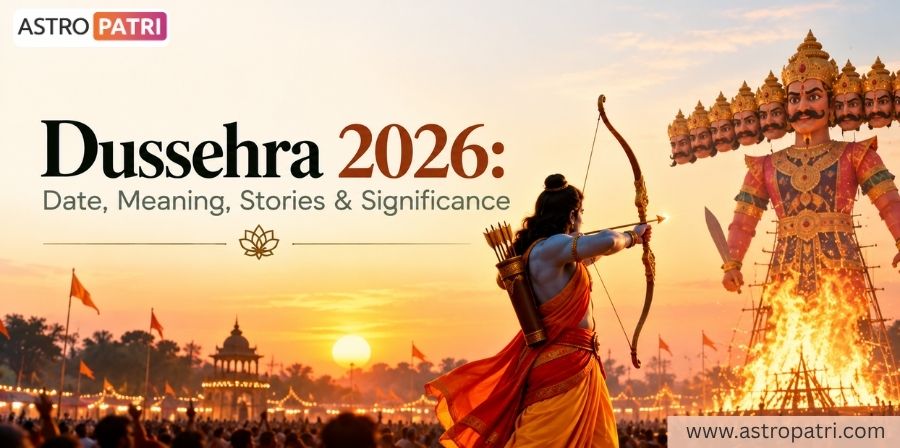
Dussehra and Vijayadashami are two names for the same Hindu festival, celebrated on the tenth day of Ashwin’s bright fortnight. The occasion carries deep religious and cultural significance across India, although customs vary by region. Dussehra is widely associated with Lord Rama’s victory over Ravana, marked by the tradition of Ravan Dahan. Vijayadashami also celebrates Maa Durga’s victory over Mahishasura, symbolising the triumph of good over evil.
In 2026, Dussehra falls on October 20 in most parts of India, while Bengal’s Vijayadashami is observed on October 21. Explore the meaning behind both names, the mythological stories, regional rituals and Vijay Muhurat to understand why this festival remains an important celebration across the country.
Yes, Dussehra and Vijayadashami generally refer to the same Hindu festival, observed on the tenth day of the bright fortnight of the Hindu month of Ashwin. The difference lies mainly in the name’s meaning, regional traditions and the story being celebrated.
Vijayadashami combines two Sanskrit words: Vijaya, meaning victory, and Dashami, meaning the tenth lunar day. Together, the name signifies victory on Dashami.
The name Dussehra is commonly associated with Lord Rama’s victory over Ravana. In many parts of India, people celebrate the occasion with Ramlila performances and Ravan Dahan, the ceremonial burning of Ravana’s effigy.
In eastern India, especially West Bengal, Vijayadashami is closely connected with Maa Durga’s victory over Mahishasura and the conclusion of Durga Puja. Both traditions celebrate the defeat of destructive forces and the restoration of righteousness.
The Ramayana recounts the conflict between Lord Rama and Ravana, the king of Lanka. After Ravana abducted Mata Sita, Lord Rama set out to rescue her, supported by Lakshmana, Hanuman and an army of allies.
The battle between Rama and Ravana became a defining moment in the epic. Lord Rama ultimately defeated Ravana and rescued Mata Sita, restoring justice after Ravana’s misuse of power.
Dussehra commemorates this victory. Across many North Indian cities and towns, communities organise Ramlila, dramatic performances depicting episodes from the Ramayana. The festivities often culminate in the burning of large effigies of Ravana, his brother Kumbhakarna and his son Meghnad.
But the ritual is not simply about a battle from mythology. Ravana’s defeat also encourages reflection on the consequences of ego, arrogance and the misuse of knowledge or power. The celebration invites people to consider which destructive tendencies they need to overcome in their own lives.
Vijayadashami has another powerful association in Hindu tradition: Maa Durga’s victory over Mahishasura.
According to the Devi Mahatmya tradition, Mahishasura acquired extraordinary power and challenged the gods. Unable to overcome him, the gods’ divine energies came together to manifest Maa Durga, who confronted the demon in battle.
After a prolonged struggle, the goddess defeated Mahishasura. Her victory represents the power of divine feminine energy and the triumph of righteousness over destructive forces.
This story gives Vijayadashami particular importance during Durga Puja. In West Bengal and several other eastern regions, the day marks the farewell to Maa Durga after days of worship, cultural gatherings and community celebrations. Devotees participate in Sindoor Khela in some Bengali communities before the idol immersion, known as Durga Visarjan.
The two stories are different, but they share a central idea. Whether the celebration recalls Lord Rama or Maa Durga, it honours courage, justice and the defeat of evil.
Dussehra 2026 will be celebrated on Tuesday, October 20, in most parts of India. However, some regional observances, including Bengal’s Vijayadashami, fall on Wednesday, October 21. The difference occurs because the Dashami lunar date continues into the following afternoon.
According to the Delhi Panchang, the key timings are as follows.
| Dussehra 2026 detail | Date and time |
| Dussehra | Tuesday, October 20, 2026 |
| Dashami Tithi begins | October 20, 12:50 PM |
| Dashami Tithi ends | October 21, 2:11 PM |
| Vijay Muhurat in Delhi | October 20, 1:59 PM to 2:45 PM |
| Bengal Vijayadashami | Wednesday, October 21, 2026 |
These timings are for Delhi and should not be treated as universal timings for every city. Local Panchang calculations and regional customs may differ. Check your local calendar before planning a puja or other observance.
Vijay Muhurat is traditionally regarded as an auspicious period for certain Vijayadashami rituals, including Aparajita Puja. Ravan Dahan, meanwhile, is generally organised in the evening according to local event schedules.
Shami Puja is an important Vijayadashami tradition in several Hindu communities. Its significance is often associated with an episode from the Mahabharata involving the Pandavas.
During their period of exile, the Pandavas concealed their weapons in a Shami tree before living in disguise. After completing that period, they retrieved their weapons. The episode connects the tree with courage, preparation and victory.
On Dussehra, some devotees worship the Shami tree or exchange its leaves as a gesture of goodwill. Practices vary by region and family tradition, so not every household observes this ritual.
Aparajita Puja, dedicated to the goddess associated with invincibility, and Seema Avalanghan, a traditional symbolic crossing of boundaries, are also associated with Vijayadashami in certain communities.
Many Hindu traditions consider Vijayadashami a favourable occasion for new beginnings. Families may choose the day to begin learning, launch a venture, purchase or worship tools, or take up an activity they have been planning.
The practice reflects the festival’s association with confidence, progress and overcoming obstacles. In some regions, children are introduced to writing or learning through traditional ceremonies.
There is no single ritual followed by every community. People usually observe the day according to their family customs, local traditions and Panchang guidance.
Ravana is traditionally depicted with ten heads, making his effigy one of the most recognisable symbols of Dussehra. The ten heads have inspired different interpretations in religious and popular traditions.
They are often understood as representing multiple aspects of human knowledge, power or negative tendencies. In contemporary explanations, they may symbolise qualities such as anger, greed, pride and attachment that can lead a person away from wisdom.
This interpretation adds a personal dimension to Ravan Dahan. Beyond watching an effigy burn, the occasion encourages people to reflect on habits and attitudes they wish to leave behind.
Dussehra and Vijayadashami bring different mythological stories together through one enduring message: the victory of righteousness over destructive forces. Lord Rama’s battle against Ravana and Maa Durga’s defeat of Mahishasura continue to shape how communities celebrate the festival.
Whether the day is marked by Ravan Dahan, Durga Visarjan, Shami Puja or prayers for new beginnings, its significance reaches beyond the rituals. It offers an opportunity to reflect on courage, responsibility and the choices that help people move towards a better life.
1. Is Dussehra different from Vijayadashami?
Dussehra and Vijayadashami generally refer to the same festival. Dussehra is widely associated with Lord Rama’s victory over Ravana, while Vijayadashami also commemorates Maa Durga’s victory over Mahishasura.
2. When is Dussehra in 2026?
Dussehra falls on Tuesday, October 20, 2026, in most parts of India. Bengal’s Vijayadashami is observed on October 21.
3. What is the significance of Vijay Muhurat on Dussehra?
Vijay Muhurat is a traditionally auspicious period associated with victory and certain religious observances. The timing varies by location, so devotees should consult their local Panchang.
4. Why is Ravana burned on Dussehra?
Ravan Dahan symbolises Lord Rama’s victory over Ravana and the triumph of righteousness over wrongdoing. It also encourages reflection on arrogance, ego and the misuse of power.
5. Why does Bengal celebrate Vijayadashami differently?
In Bengal, Vijayadashami marks the conclusion of Durga Puja and is associated with Maa Durga’s victory over Mahishasura. The farewell rituals and Durga Visarjan give the day a distinct regional character.
Instant Report Based on Our Proprietary Framework, Developed by Experts