-
 Translate
- Astropatri Values
- My Account
Translate
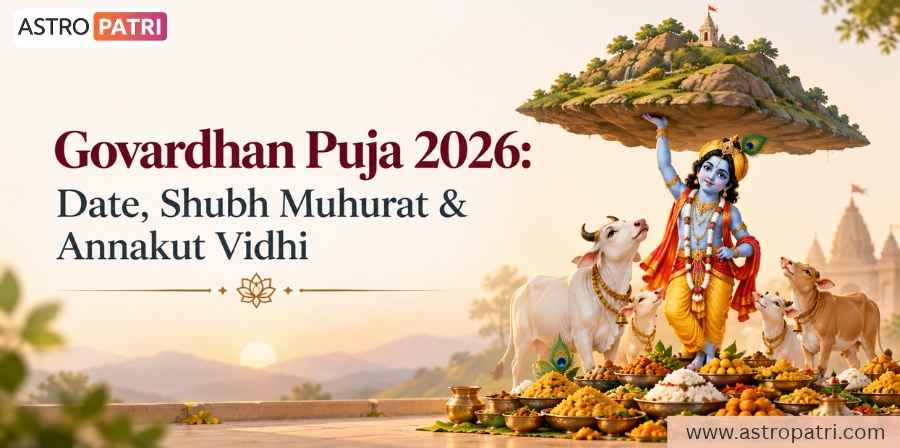
Govardhan Puja falls on Tuesday, November 10, 2026. In New Delhi, the morning puja muhurat is from 6:40 AM to 8:50 AM. The festival recalls how Lord Krishna lifted Govardhan Hill to protect the people of Braj and their cattle from torrential rain sent by Indra.
Families mark the day by worshipping Krishna, preparing Annakut, offering food and sharing prasad. The rituals are rooted in a story of protection, humility and devotion, and they remain an important part of the Diwali season.
Check the date, your city’s puja muhurat, and the steps for performing the puja at home, along with the meaning of Annakut and other traditions.
Govardhan Puja falls on Kartik Shukla Pratipada, the first day of the bright lunar fortnight in Kartik. For New Delhi, the important timings are:
| Detail | Date and time |
| Govardhan Puja | Tuesday, November 10, 2026 |
| Pratipada Tithi begins | 12:32 PM, November 9 |
| Pratipada Tithi ends | 2:00 PM, November 10 |
| Morning puja muhurat | 6:39 AM to 8:49 AM |
Why is Govardhan Puja on November 10 and not November 9?
The Pratipada Tithi begins on November 9 but is still prevailing at sunrise on November 10. Under the Udaya Tithi rule, Govardhan Puja is therefore observed on November 10, 2026.
The morning puja muhurat varies by location because sunrise differs across India. The following timings are listed for November 10, 2026.
| City | Morning Puja Muhurat |
| New Delhi | 6:39 AM to 8:49 AM |
| Mumbai | 6:43 AM to 8:58 AM |
| Bengaluru | 6:16 AM to 8:35 AM |
| Kolkata | 5:45 AM to 7:59 AM |
| Chennai | 6:05 AM to 8:24 AM |
| Hyderabad | 6:18 AM to 8:34 AM |
| Pune | 6:38 AM to 8:54 AM |
| Ahmedabad | 6:49 AM to 9:03 AM |
| Jaipur | 6:42 AM to 8:53 AM |
| Lucknow | 6:21 AM to 8:33 AM |
| Chandigarh | 6:44 AM to 8:53 AM |
| Patna | 6:03 AM to 8:15 AM |
These are location-specific Panchang timings. Small differences of a minute or two may occur between calculations. Confirm your city’s timing before beginning the puja.
According to the Srimad Bhagavata Purana, the people of Vrindavan traditionally worshipped Indra, the deity associated with rain. Krishna encouraged them to honour Govardhan Hill and the natural resources that supported their cattle and livelihoods.
The villagers followed his advice, which angered Indra. He sent a powerful storm and torrential rain towards Braj, putting the villagers and their cattle in danger.
Krishna lifted Govardhan Hill with one hand, giving everyone shelter beneath it. He held the hill for seven days and nights until Indra recognised his mistake and stopped the storm.
The story explains why Govardhan Hill is worshipped during the festival. It also offers a lesson about humility, protection and the importance of recognising the natural world that sustains life.
You can perform Govardhan Puja at home with a few essentials and sincere devotion. Prepare the puja area before the muhurat so you can complete the ritual without rushing.
Items needed for Govardhan Puja
Keep a picture or idol of Krishna, flowers, a diya, incense, kumkum, rice, water, fruits, sweets and vegetarian food offerings ready. You may also use cow dung or clean clay to make a symbolic Govardhan Hill, according to your family tradition.
How to make a Govardhan Hill
Traditionally, devotees shape cow dung into a small hill and decorate it with flowers and leaves. If cow dung is unavailable or unsuitable for your household, clean clay or a hill-shaped arrangement of flowers and rangoli materials can serve as a symbolic alternative.
Govardhan Puja vidhi step by step
The exact procedure varies across households and temples. Follow the custom you observe at home.
Annakut means a mountain of food. Devotees prepare a variety of vegetarian dishes and offer them to Lord Krishna as part of Govardhan Puja.
Why are 56 dishes offered as Chhappan Bhog?
A popular devotional explanation connects Chhappan Bhog with the seven days Krishna held Govardhan Hill. Krishna was traditionally offered eight meals each day. The 56 dishes are believed to represent the meals missed during those seven days.
What foods can you offer?
Common offerings include rice, dal, puri, seasonal vegetables, kadhi, halwa, laddoo, fruits, dry fruits and milk-based sweets. Families may prepare 56 dishes or make a smaller offering according to their means and traditions.
After the puja, the food is distributed as prasad among family members, devotees and guests. The sharing of Annakut is an important part of the celebration.
Govardhan Puja celebrates Krishna’s protection of the people of Braj and highlights the importance of humility, nourishment and care for living beings. The story reminds devotees that strength is best used to protect others rather than display power.
Astrological significance
Tuesday is associated with Mangal, or Mars, in Vedic astrology. Mars traditionally represents courage, action, energy and land. Govardhan Puja’s association with protection and the earth provides a point of spiritual reflection, but the weekday alone does not determine a person’s astrological results.
Devotional offerings by Rashi
Some devotees choose offerings according to their Rashi and its ruling planet. These are optional devotional suggestions, not mandatory rules or promises of results.
| Rashi | Offering to Consider |
| Aries (Mesh) | Red flowers |
| Taurus (Vrishabh) | White sweets |
| Gemini (Mithun) | Green moong |
| Cancer (Kark) | Milk-based sweets |
| Leo (Singh) | Wheat-based prasad |
| Virgo (Kanya) | Green moong |
| Libra (Tula) | Mishri or white sweets |
| Scorpio (Vrishchik) | Jaggery |
| Sagittarius (Dhanu) | Yellow sweets or bananas |
| Capricorn (Makar) | Sesame-based food |
| Aquarius (Kumbh) | A simple food offering |
| Pisces (Meen) | Bananas or yellow sweets |
Choose an offering that suits your household’s practice and is appropriate for worshipping Krishna.
Govardhan Parikrama
Govardhan Parikrama is the traditional practice of walking around Govardhan Hill as an act of devotion. Pilgrims visit sacred places associated with Krishna and complete the circumambulation according to their faith and ability. Those unable to travel to Braj may offer prayers at home or perform a symbolic circumambulation if their family observes this practice.
Gau Puja
Cows are closely associated with Krishna, who is known as Gopal and Govinda. During Gau Puja, devotees may offer flowers, provide suitable fodder and pray for the well-being of cattle. The ritual reflects the importance of cows in the pastoral traditions of Braj.
When participating in Gau Puja, treat the animals gently and follow the caretaker’s advice about suitable food.
Braj, Mathura and Vrindavan
Braj is closely associated with Krishna’s childhood. Devotees visit temples, make Annakut offerings and undertake Govardhan Parikrama. Devotional singing and community meals are also part of the celebrations.
Nathdwara
Annakut is an important tradition at Nathdwara, where devotees worship Shrinathji. Food is arranged as a large offering to the deity according to the temple’s customs.
Bali Pratipada, Padwa and Bestu Varas
In Maharashtra, the day is associated with Bali Pratipada or Bali Padwa. In Gujarat, Kartik Shukla Pratipada is also celebrated as Bestu Varas, or Gujarati New Year. These observances fall during the wider Diwali period but have their own regional traditions.
Some families also observe Dyuta Krida, or traditional games, on Pratipada. According to the story, Shiva and Parvati played dice for the first time on Kartik Pratipada, and families believe that playing on this day brings Parvati’s blessings. The early morning (Pratahkal) is considered the best time to play. Keep the game friendly and play without wagering money.
Govardhan Puja brings together Krishna’s story, the Annakut offering and the worship of Govardhan Hill. Check your city’s puja muhurat, prepare a simple offering and follow the traditions of your household.
The festival is an opportunity to share food, offer prayers and remember the importance of caring for people, animals and the natural world.
Shubh Govardhan Puja to you and your family.
1. When is Govardhan Puja in 2026?
Govardhan Puja falls on Tuesday, November 10, 2026, in India under the Udaya Tithi convention.
2. What is the Govardhan Puja muhurat in New Delhi?
The morning puja muhurat is listed from 6:39 AM to 8:49 AM on November 10, 2026.
3. Why is Govardhan Puja celebrated?
It commemorates Krishna lifting Govardhan Hill to protect the people of Braj and their cattle from Indra’s storm. The festival also includes Annakut and Gau Puja.
4. How long did Krishna hold Govardhan Hill?
According to the traditional account, Krishna held Govardhan Hill for seven days and nights.
5. Can Govardhan Puja be performed without cow dung?
Yes. You can use clean clay or create a symbolic hill with flowers and rangoli materials if cow dung is unavailable or unsuitable for your household.
6. What is Chhappan Bhog?
Chhappan Bhog is the traditional offering of 56 food items to Lord Krishna. The number is popularly linked with eight meals a day over the seven days Krishna held Govardhan Hill.
7. What should be done with the Govardhan model after the puja?
Follow your household or temple custom for disposing of the model respectfully. Return natural materials to an appropriate place without littering or polluting a water source.





Instant Report Based on Our Proprietary Framework, Developed by Experts