-
 Translate
- Astropatri Values
- My Account
Translate

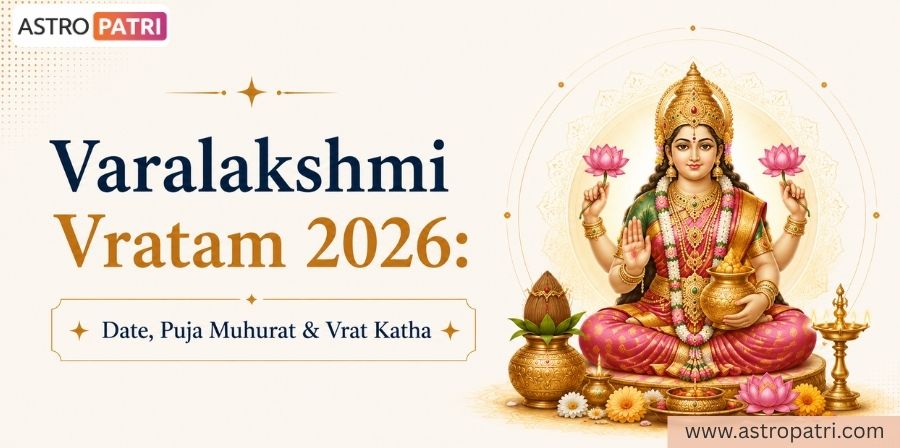
Varalakshmi Vratam 2026 will be observed on Friday, August 28. The festival is dedicated to Goddess Varalakshmi, a form of Goddess Mahalakshmi associated with prosperity, well-being, family happiness and the fulfilment of worthy wishes.
For many families, this is more than a day for asking Goddess Lakshmi for wealth. The vrat is traditionally observed with prayers for the well-being of the husband and family, children, prosperity, good fortune and a stable household.
A distinctive feature of Varalakshmi Puja is its connection with the Ashtalakshmi, the eight forms associated with different kinds of abundance, including wealth, learning, strength, peace and prosperity.
Varalakshmi Vratam falls on the Friday of Shravana Shukla Paksha. In 2026, it will be observed on August 28.
The Panchang gives four suitable fixed-Lagna periods for Varalakshmi Puja:
| Puja Muhurat | Time | Duration |
| Morning | 5:57 AM to 7:29 AM | 1 hour 32 minutes |
| Afternoon | 12:05 PM to 2:23 PM | 2 hours 19 minutes |
| Evening | 6:09 PM to 7:37 PM | 1 hour 27 minutes |
| Midnight | 10:37 PM to 12:33 AM, August 29 | 1 hour 56 minutes |
The evening period overlapping Pradosh is traditionally considered especially suitable for Varalakshmi worship.
The reason several timings are given is important. Varalakshmi Puja is traditionally performed during a fixed Lagna, with the belief that worship during such a period supports lasting prosperity.
Varalakshmi is regarded as a form of Goddess Mahalakshmi and the consort of Lord Vishnu.
The name itself carries the idea behind the festival. Vara means boon, so Varalakshmi is understood as the form of Lakshmi who grants blessings and fulfils worthy desires.
The vrat is especially popular in Andhra Pradesh, Telangana, Karnataka, Tamil Nadu and Maharashtra. In these regions, married women traditionally observe it for the well-being of their husbands and family members.
The observance is not limited to married women in the broader tradition. Men and others who wish to worship Goddess Varalakshmi can also observe the vrat according to their family customs.
The most interesting part of Varalakshmi Vrat is its connection with eight forms of Lakshmi.
Worshipping Varalakshmi is traditionally regarded as equivalent to seeking the blessings of the Ashtalakshmi. These forms represent different dimensions of prosperity, including:
This gives the festival a broader meaning. Prosperity is not understood as money alone. A peaceful home, knowledge, good relationships, strength and contentment are also treated as forms of abundance.
Varalakshmi Vratam is particularly popular among married women in South Indian households.
Traditionally, women pray for the health and well-being of their husbands, children and other family members. The vrat is also associated with wishes for prosperity, happiness and a stable family life.
However, the tradition does not restrict Varalakshmi worship only to married women. The vrat can also be observed by men and others who wish to seek the blessings of Goddess Lakshmi.
The exact customs differ between families and regions, so the method followed at home can vary.
The Varalakshmi Puja follows an elaborate sequence of offerings. The detailed tradition includes 32 upacharas, known as Dvatrinshopachara Puja. A sixteen-step form, called Shodashopachara Puja, is also recognised.
The worship begins with meditation and invocation of Goddess Varalakshmi. Devotees then offer a seat, water, Panchamrita bath, clothing, jewellery, sandalwood, auspicious items and flowers.
The later stages include incense, lamp, food offerings, betel leaves, Dakshina, Aarti, the sacred Dorak thread, prayers, Vayana and the final dedication of the Puja.
A simplified understanding of the sequence is:
The detailed Puja tradition includes specific mantras for each stage, along with offerings such as flowers, Bilva leaves, food, Dakshina and Vayana.
One of the distinctive parts of Varalakshmi Vratam is the Dorak, a sacred thread.
It is accepted during the Puja and then tied on the hand while making a prayer for Sri, Yash and Saubhagya, meaning prosperity, good reputation and auspiciousness.
This is one of the details that sets Varalakshmi Puja apart from a regular Lakshmi worship.
Vayana refers to the traditional food or sweet offering made to Goddess Varalakshmi.
The Puja tradition includes a specific Vayana offering and concludes with the distribution of five Vayanas along with Dakshina to people associated with the observance, including a Brahmin, ascetic, goddess representation, celibate and married woman according to the prescribed ritual.
The exact preparation and distribution can vary according to regional and family customs.
The story behind Varalakshmi Vratam begins on Mount Kailasa, where Lord Shiva and Goddess Parvati were playing Chaupar.
A disagreement arose when both believed they had won the game. They asked Chitranemi, who was present there, to decide the winner.
Chitranemi was a devotee of Lord Shiva. He therefore declared Shiva the winner, even though the decision was not truthful.
Goddess Parvati became angry because he had knowingly spoken falsely. She cursed Chitranemi with a serious disease.
Chitranemi was frightened and distressed. Lord Shiva then asked Parvati to show compassion because Chitranemi was otherwise learned and had surrendered.
Parvati eventually gave him a way to become free from the curse. He would need to encounter celestial women observing the Varalakshmi Vrat and follow the same worship.
Chitranemi later came across celestial women performing the Varalakshmi Puja near a lake.
He asked them about their worship and learned about the vrat.
They explained its method and significance. Chitranemi then decided to observe it himself.
After following the prescribed worship, he was freed from the curse and eventually returned to Mount Kailasa.
There, Goddess Parvati welcomed him with compassion.
The story then gives Varalakshmi Vrat an even wider significance by mentioning other devotees who are believed to have received important blessings through the vrat.
The traditional account says that Goddess Parvati herself observed this vrat with the desire for a son and received Kartikeya. It also connects the vrat with King Vikramaditya and Nanda.
The larger message is clear. The story presents Varalakshmi worship as a practice associated with faith, prosperity, family wishes and divine grace.
The detailed Puja tradition includes several types of offerings.
Important items include:
The Puja tradition specifically includes offerings of Saubhagya Dravya, such as turmeric, kumkum, sindoor and kajal.
The complete 32-step method is detailed and can be followed by those who perform the traditional form of Varalakshmi Puja. Families that follow a shorter method can continue with their established customs.
Varalakshmi Vratam is observed on the Friday of Shravana Shukla Paksha.
Friday already holds a strong traditional association with Goddess Lakshmi, making this observance particularly significant for devotees seeking her blessings.
The festival also falls close to Raksha Bandhan and Shravana Purnima, placing it within an important period of the Shravana festival calendar.
The traditional purpose of the vrat includes seeking:
The Ashtalakshmi connection also explains why devotees look beyond financial wealth. The worship includes prayers for learning, peace, love, strength and other forms of well-being.
Varalakshmi Vratam is traditionally associated with prosperity, family welfare, good fortune and the many forms of abundance represented by Goddess Lakshmi.
What makes the festival especially meaningful is its wider idea of prosperity. Money is one part of a good life. Peace at home, good health, learning, love, strength and contentment matter too.
On August 28, 2026, devotees can choose one of the prescribed Puja timings and follow the rituals according to their family tradition. For those observing the complete method, the Dorak, Vayana and detailed offerings remain important parts of the worship.
The heart of Varalakshmi Vratam remains simple: pray for prosperity, but remember the many forms prosperity can take in a family and in a person’s life.
When is Varalakshmi Vratam in 2026?
Varalakshmi Vratam will be observed on Friday, August 28, 2026.
What is the Varalakshmi Puja Muhurat in 2026?
Four suitable timings are given for August 28: 5:57 AM to 7:29 AM, 12:05 PM to 2:23 PM, 6:09 PM to 7:37 PM, and 10:37 PM to 12:33 AM. The evening period is traditionally considered especially suitable because it overlaps Pradosh.
Who should observe Varalakshmi Vratam?
The vrat is especially popular among married women in Andhra Pradesh, Telangana, Karnataka, Tamil Nadu and Maharashtra. The broader tradition also allows men and others to observe Varalakshmi worship according to their faith and family customs.
What is offered during Varalakshmi Puja?
Common offerings include flowers, turmeric, kumkum, sandalwood, jewellery, incense, a lamp, Naivedya, Dakshina, sacred thread and Vayana. The detailed Puja method contains 32 stages.
What is the significance of the Dorak?
The Dorak is a sacred thread accepted and tied during Varalakshmi Puja. The associated prayer asks Goddess Varalakshmi for prosperity, good reputation and auspiciousness.
What is the Varalakshmi Vrat Katha?
The traditional story tells how Chitranemi was cursed by Goddess Parvati after falsely declaring Lord Shiva the winner of a game. He later learned about Varalakshmi Vrat from celestial women, observed it and was freed from the curse.
Is Varalakshmi Vrat only for married women?
No. Although married women are the main observers in several regions, the tradition states that Varalakshmi fasting is not restricted to women. Men may also observe it.
Instant Report Based on Our Proprietary Framework, Developed by Experts