-
 Translate
- Astropatri Values
- My Account
Translate

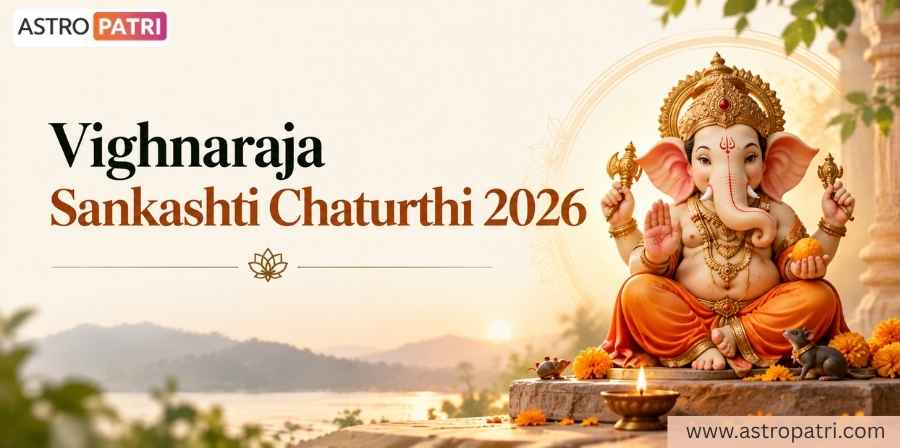
Vighnaraja Sankashti Chaturthi 2026 falls on Tuesday, September 29. Dedicated to Lord Ganesha in his Vighnaraja form, this Sankashti is traditionally associated with overcoming obstacles, gaining clarity and seeking Ganesha’s blessings during difficult phases.
For Delhi, Chaturthi Tithi begins at 5:09 PM on September 29 and ends at 2:55 PM on September 30. The Moon rises at 7:44 PM on September 29. Since moonrise varies by location, devotees in other cities should follow their local Chandrodaya time.
Since the vrat falls on Tuesday, Vighnaraja Sankashti is also known as Angarki Sankashti Chaturthi.
| Details | Information |
| Date | Tuesday, September 29, 2026 |
| Chaturthi Tithi Begins | 5:09 PM, September 29 |
| Chaturthi Tithi Ends | 2:55 PM, September 30 |
| Moonrise in Delhi | 7:44 PM, September 29 |
| Paksha | Krishna Paksha |
| Deity | Lord Vighnaraja Ganesha |
| Amanta Month | Bhadrapada |
| Purnimanta Month | Ashwina |
| Special Name | Angarki Sankashti |
Note: The timings above are for Delhi. Moonrise and other Panchang timings can differ from one city to another.
The Vighnaraja Sankashti vrat is observed on September 29, 2026.
The confusion arises because the Chaturthi Tithi continues into September 30. In Delhi, the Tithi begins at 5:09 PM on September 29 and ends at 2:55 PM on September 30.
So there is a difference between the vrat date and the Tithi ending date:
Vrat date: September 29, 2026
Chaturthi Tithi ends: September 30, 2026
Yes. A Sankashti Chaturthi that falls on Tuesday is traditionally known as Angarki Sankashti Chaturthi. Since September 29, 2026 is a Tuesday, this year’s Vighnaraja Sankashti carries the Angarki designation as well.
This is why you may see both Vighnaraja Sankashti and Angarki Sankashti used when referring to the September 29 observance.
Sankashti Chaturthi is observed on Krishna Paksha Chaturthi and is dedicated to Lord Ganesha. Each monthly Sankashti is traditionally associated with a particular form of Ganesha, and this observance is known as Vighnaraja Sankashti.
The name itself explains its significance.
Vighna means obstacle or hindrance, while Raja means ruler or king. Vighnaraja therefore represents Lord Ganesha as the one who has authority over obstacles.
This makes the observance especially meaningful when a person is dealing with repeated delays, uncertainty or a situation that seems difficult to move beyond.
There are different traditional accounts associated with the Vighnaraja form.
One story concerns Vighnasura, who was creating obstacles. After encountering Lord Ganesha’s power, Vighnasura surrendered and sought refuge in him. He then requested that his name be associated with Ganesha, after which Lord Ganesha became known as Vighnaraja.
Another tradition describes Vighnaraja as the form of Ganesha who appeared to defeat Mamtasura.
Although the stories differ, their central idea remains closely connected. Vighnaraja represents the ability to bring obstacles under control.
The exact customs may differ according to family and regional traditions. A simple observance can be performed in the following way.
Begin the day after bathing and wearing clean clothes. Clean the place of worship and place an image or murti of Lord Ganesha.
Take a sankalp to observe the vrat and spend the day in prayer, discipline and remembrance of Ganesha.
Sankashti fasting can be nirjala, phalahar or partial, depending on one’s customary practice.
Those following a phalahar vrat may have fruits, milk, nuts, sabudana and other foods permitted during fasting. Those observing a stricter tradition may avoid food altogether until the prescribed time.
Keep the offerings simple:
Offer the puja samagri to Lord Ganesha and recite a prayer or mantra.
A commonly recited mantra is:
ॐ गं गणपतये नमः
Om Gam Ganapataye Namah
You may also recite Ganesh Chalisa, Ganapati Atharvashirsha, or a Ganesha prayer followed in your family.
Read or listen to the Vighnaraja Sankashti Vrat Katha as part of the evening observance.
Sankashti vrat is traditionally completed after the Moon rises. Devotees perform the prescribed evening worship, offer arghya to Chandra and then break the fast.
For Delhi, the Moon rises at 7:44 PM on September 29, 2026.
| What to Do | What to Avoid |
| Take a sankalp for the vrat and begin the day with cleanliness and devotion. | Avoid treating the vrat only as a food restriction. |
| Worship Lord Ganesha with durva, flowers, diya, fruits and traditional offerings. | Avoid unnecessary arguments, anger and harsh speech during the day. |
| Recite ॐ गं गणपतये नमः or follow the Ganesha prayer observed in your family. | Avoid eating foods that are restricted under your chosen vrat tradition. |
| Read or listen to the Vighnaraja Sankashti Vrat Katha. | Avoid ending the fast before the prescribed moonrise. |
| Check the Moonrise time for your own city before planning the evening worship. | Avoid relying on another city’s moonrise time, as Chandrodaya varies by location. |
| Offer Chandra arghya after moonrise and complete the prescribed worship before breaking the fast. | Avoid changing established family or regional vrat practices without understanding their tradition. |
| Keep the day simple, disciplined and focused on prayer and remembrance of Lord Ganesha. | Avoid unnecessarily complicating the puja with rituals that are not part of your tradition. |
The traditional Vighnaraja Sankashti Katha centres on Lord Krishna, Aniruddha and Banasura.
According to the account, Krishna’s grandson Aniruddha was taken to Banasura’s palace. Krishna sought guidance from Lomasha Rishi, who advised him to observe the Sankashti vrat dedicated to Lord Ganesha.
Krishna followed the prescribed observance. The story then leads to his confrontation with Banasura and the eventual recovery of Aniruddha.
There is a thoughtful idea within this story. Krishna does not simply wait for his difficulty to disappear. He seeks guidance, follows the prescribed discipline and then takes action.
That is one of the deeper ways to understand Sankashti. Prayer creates inner steadiness, while sincere effort remains necessary to face the situation itself.
The significance of Vighnaraja Sankashti lies in meeting obstacles with wisdom.
Lord Ganesha is traditionally associated with intellect, discernment and the removal of impediments. Vighnaraja gives special importance to the obstacles standing between a person and their goal.
A delay at work, uncertainty over a major decision, repeated setbacks or difficulty beginning something important can all feel like a roadblock. The symbolism of Vighnaraja does not suggest that every problem simply vanishes after prayer.
It offers another way of looking at the situation. Before asking for the obstacle to disappear, a person can also seek the clarity to understand what created it and what needs to change.
The vrat is traditionally completed after moonrise, followed by the prescribed evening worship and Chandra arghya.
For Delhi, moonrise is at 7:44 PM on September 29, 2026. Devotees in other locations should follow the moonrise timing for their own city.
Fasting practices differ.
Some devotees observe a nirjala fast, while others follow phalahar or take one permitted meal. Fruits, milk, nuts and sabudana are commonly included in fasting diets.
The exact rules can vary according to family, regional and personal tradition, so the practice followed in your household should take priority.
Vighnaraja Sankashti Chaturthi is a day dedicated to Lord Ganesha as the master of obstacles. Its rituals, stories and symbolism all return to a practical spiritual idea: when something stands in your way, clarity matters as much as persistence.
On September 29, 2026, devotees can observe the vrat with fasting, Ganesha Puja, the Vighnaraja Katha and worship after moonrise. As an Angarki Sankashti, this year’s observance also carries the traditional Tuesday designation.
When is Vighnaraja Sankashti Chaturthi in 2026?
Vighnaraja Sankashti Chaturthi will be observed on Tuesday, September 29, 2026. Although the Chaturthi Tithi continues into September 30, the vrat is observed on September 29.
What is the moonrise time for Vighnaraja Sankashti 2026?
The Moon will rise at 7:44 PM in Delhi on September 29, 2026. Moonrise varies by location, so devotees should check the Chandrodaya time for their own city.
When does Vighnaraja Sankashti Chaturthi Tithi begin and end?
In Delhi, Chaturthi Tithi begins at 5:09 PM on September 29 and ends at 2:55 PM on September 30, 2026. The Sankashti vrat is observed on September 29.
Is Vighnaraja Sankashti 2026 an Angarki Sankashti?
Yes. Vighnaraja Sankashti on September 29, 2026 is also known as Angarki Sankashti because it falls on a Tuesday.
When should the Vighnaraja Sankashti fast be broken?
The Sankashti fast is traditionally broken after moonrise and the evening worship. Devotees generally complete Ganesha Puja, offer arghya to the Moon and then conclude the vrat.
How is Vighnaraja Sankashti Puja performed?
Vighnaraja Sankashti Puja begins with a sankalp and Lord Ganesha worship using durva, flowers, diya and traditional offerings. Devotees recite Ganesha mantras, read the vrat katha and complete the evening observance after moonrise.
Why is it called Vighnaraja Sankashti?
Vighnaraja means the ruler of obstacles. The name is associated with traditional stories of Lord Ganesha and reflects his role as the deity worshipped for overcoming obstacles and seeking wisdom and clarity.