-
 Translate
- Astropatri Values
- My Account
Translate

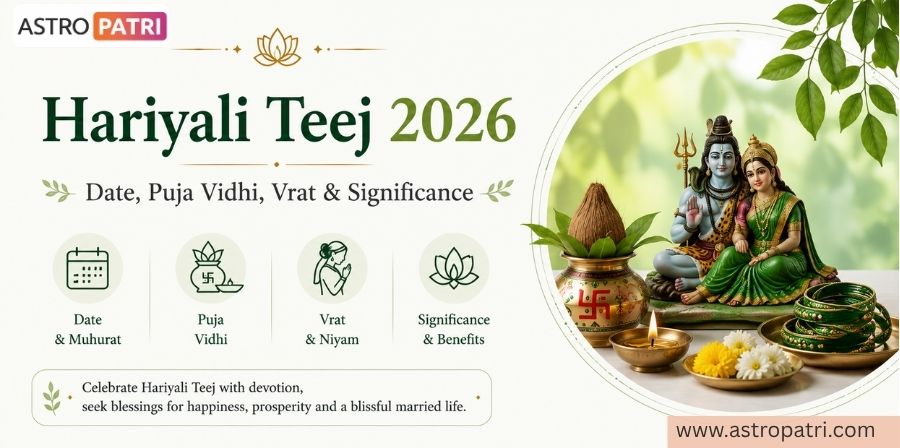
Hariyali Teej 2026 will be observed on Saturday, August 15. The festival falls on Shravana Shukla Tritiya and is dedicated to Lord Shiva and Goddess Parvati. According to the New Delhi Panchang, the Tritiya Tithi begins at 6:46 PM on August 14 and ends at 5:28 PM on August 15, 2026.
Hariyali Teej is one of the most cherished festivals of the Sawan season, especially among women in North India. Green bangles, mehendi, swings, festive clothes and Sindhara gifts are part of its familiar picture. Yet beneath these customs is an older story of Goddess Parvati’s devotion to Lord Shiva and their reunion.
For married women, the festival is traditionally associated with marital happiness and conjugal harmony. For unmarried women, prayers are often offered for a suitable life partner. The festival also creates a rare space for women to return to their parental homes, meet family, dress up, sing Teej songs and celebrate together.
Hariyali Teej will be celebrated on Saturday, August 15, 2026.
| Hariyali Teej 2026 | Details |
| Date | Saturday, August 15, 2026 |
| Tithi | Shukla Paksha Tritiya |
| Tritiya Begins | 6:46 PM, August 14 |
| Tritiya Ends | 5:28 PM, August 15 |
| Month | Shravana |
| Deities | Lord Shiva and Goddess Parvati |
| Other Names | Sawan Teej, Shravana Teej, Chhoti Teej, Sindhara Teej |
The timings above are based on the New Delhi Panchang. Local timings can differ depending on location.
Hariyali Teej is traditionally associated with the union of Shiva and Parvati.
According to Hindu tradition, Goddess Parvati undertook severe penance to win Lord Shiva as her husband. Her devotion and determination eventually led to their union. Hariyali Teej therefore carries a strong theme of love, devotion, patience and marital commitment.
This is also why married women traditionally pray for the well-being of their husbands and for harmony in married life.
The festival has another meaning that is easy to miss when focusing only on the rituals. It falls during the monsoon, when the landscape turns green and the atmosphere changes after the intense summer months. The name Hariyali Teej itself reflects this seasonal connection with greenery and renewal.
The significance of Hariyali Teej comes from the meeting of devotion, marriage, family and the monsoon season.
For married women, the festival is traditionally associated with conjugal happiness and the well-being of the family. Unmarried women may pray to Goddess Parvati for a suitable life partner.
But the celebration is also deeply social.
In many families, married daughters return to their parents’ homes for Teej. New clothes are prepared, mehendi is applied, bangles are worn and women gather around swings to sing traditional songs.
This makes Hariyali Teej different from a festival observed only through temple rituals. Much of its character comes from the way it brings women, daughters, mothers and sisters together.
Green is closely associated with Hariyali Teej because the festival arrives during the monsoon, when vegetation becomes fresh and abundant.
Women traditionally wear green sarees, suits, bangles and jewellery as part of the celebration. Green also carries associations with fertility, growth and renewal in the seasonal symbolism of the festival.
The custom has therefore become one of the most recognisable features of Hariyali Teej.
Hariyali Teej is also known as Sindhara Teej because of the tradition of sending a Sindhara to a married daughter.
A Sindhara is a collection of gifts traditionally sent by the woman’s parents to her and her in-laws. It may include:
The practice gives the festival an emotional family dimension. For a married daughter living away from her parents, receiving Sindhara is a reminder that Teej remains a celebration of her relationship with her maternal family as well.
Hariyali Teej Puja is traditionally dedicated to Goddess Parvati and Lord Shiva.
A simple observance can include:
The exact Puja Vidhi and fasting rules can vary between families and regions, so traditional family practice should be followed where applicable.
Yes. Hariyali Teej fasting is traditionally observed by many women, particularly married women praying for the well-being of their husbands and unmarried women praying for a suitable spouse.
Fasting practices differ. Some women observe a strict Nirjala fast, while others follow a modified fast according to their health, family tradition and local customs.
There is no need to follow someone else’s fasting practice simply because it is described as traditional. Anyone observing a fast should consider their health and follow the practice appropriate to their circumstances.
The image of women sitting on swings during Hariyali Teej is not merely decorative.
Swings are closely connected with the monsoon season and have become an important part of Teej celebrations, particularly in North India. Women gather together, sing traditional Teej songs and take turns on decorated swings.
The custom adds a joyful social side to a festival otherwise centred around fasting and worship.
It also reflects how seasonal festivals were traditionally woven into community life. The arrival of rain was celebrated through music, colour, food and gatherings.
Hariyali Teej is particularly popular across Rajasthan, Uttar Pradesh, Madhya Pradesh, Bihar and Jharkhand.
The customs can look different from one region to another. Some communities place greater emphasis on fasting and Puja, while others are known for elaborate swings, processions, folk songs, mehendi, traditional clothing and family gatherings.
This regional variety is part of what makes Teej such a living festival rather than a single fixed ritual.
The three major Teej festivals associated with the Sawan and Bhadrapada season are:
Hariyali Teej falls during Shravana, while Kajari Teej and Hartalika Teej come later in the season.
Hariyali Teej is also called Chhoti Teej or Shravana Teej. Kajari Teej, which comes around 15 days later, is commonly called Badi Teej.
These should not be confused with Akshaya Tritiya, which is also sometimes called Akha Teej, because it belongs to a different festival tradition.
Offerings vary according to family and regional customs, but a traditional Puja may include:
Ghevar is especially associated with Teej celebrations in North India and is commonly included in festive meals and Sindhara gifts.
The important part is to follow the customs of your household rather than trying to include every item mentioned in different online lists.
Hariyali Teej has a beautiful contrast at its heart.
There is the quiet side of the festival, expressed through fasting, prayer and the story of Goddess Parvati’s devotion to Shiva. Then there is the lively side, seen in green clothes, bangles, mehendi, swings, songs, sweets and daughters returning to their parents’ homes.
Both belong to Teej.
On August 15, 2026, women across several parts of India will once again celebrate this meeting of devotion and family tradition. For some, the day will be centred around a fast and Puja. For others, it will mean sitting with their mother, applying mehendi with sisters, receiving Sindhara or simply returning home for Sawan.
That is perhaps what gives Hariyali Teej its lasting place in the Indian festive calendar. It preserves an ancient story of Shiva and Parvati while remaining closely connected to ordinary family life.
When is Hariyali Teej 2026?
Hariyali Teej will be celebrated on Saturday, August 15, 2026.
What is the significance of Hariyali Teej?
The festival celebrates the union of Lord Shiva and Goddess Parvati and is traditionally associated with marital happiness, devotion and family well-being.
What is the Hariyali Teej fasting tradition?
Many women observe a fast for marital happiness and the well-being of their husbands. Unmarried women may also fast and pray for a suitable life partner. Fasting customs vary by family and region.
Why is Hariyali Teej called Sindhara Teej?
The name comes from the tradition of parents sending a Sindhara, a collection of sweets, mehendi, bangles, clothes and other gifts, to their married daughter and her in-laws.
What should women wear on Hariyali Teej?
Green sarees, suits, bangles and other traditional adornments are especially popular because green represents the monsoon season, freshness and renewal.
Is Hariyali Teej only for married women?
No. While married women traditionally pray for marital happiness and their husbands’ well-being, unmarried women also observe Teej and pray to Goddess Parvati for a suitable life partner.
Who are the deities worshipped on Hariyali Teej?
Hariyali Teej is dedicated to Lord Shiva and Goddess Parvati, with Goddess Parvati receiving particular importance in prayers for marital and family happiness.
Instant Report Based on Our Proprietary Framework, Developed by Experts