-
 Translate
- Astropatri Values
- My Account
Translate

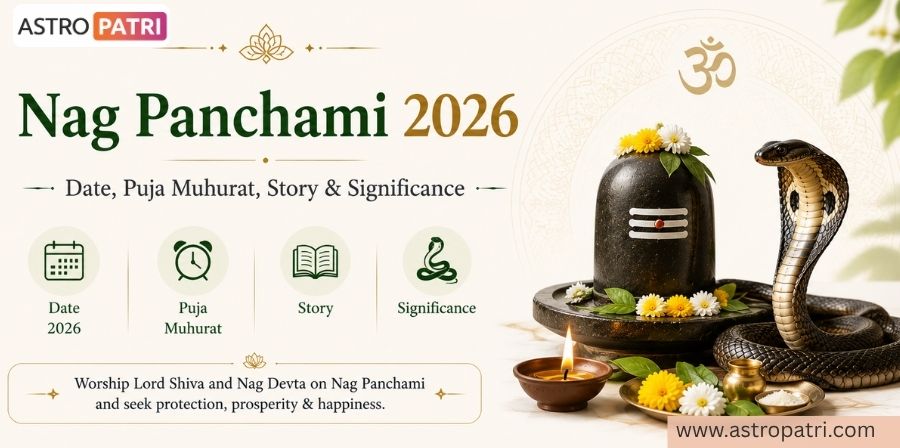
Nag Panchami 2026 will be celebrated on Monday, August 17. The festival falls on Shukla Paksha Panchami during the month of Shravana. The Nag Panchami Puja Muhurat is 5:51 AM to 8:29 AM, according to the New Delhi Panchang.
But why are Nagas worshipped on Panchami?
The answer lies in an ancient story involving Kadru, Vinata, Naga King Vasuki, King Janamejaya and Astika Muni. What begins as a dispute over a divine horse eventually leads to a curse, a massive serpent sacrifice and the rescue of the Nagas.
That story explains why Panchami holds such an important place in the Nag Panchami tradition.
Here are the key Panchang details for Nag Panchami 2026:
| Nag Panchami 2026 | Details |
| Date | Monday, August 17, 2026 |
| Tithi | Shukla Paksha Panchami |
| Panchami Tithi Begins | 4:52 PM on August 16 |
| Panchami Tithi Ends | 5:00 PM on August 17 |
| Puja Muhurat | 5:51 AM to 8:29 AM |
| Puja Duration | 2 hours 37 minutes |
| Month | Shravana |
These timings are based on the New Delhi Panchang. The local Muhurat can vary depending on your location.
Nag Panchami is a traditional festival dedicated to the worship of Nag Devta and revered serpent deities.
People observe the day with prayers, fasting and family rituals. In several traditions, women also pray for the well-being of their brothers and family members.
However, the reason Panchami is observed as an important day for the Nagas is found in the Nag Panchami Vrat Katha.
The story connects Panchami with the protection of the Nagas from King Janamejaya’s Sarpa Yajna, or serpent sacrifice.
To understand this connection, we need to go back to the beginning of the story.
The story begins with Uchchaihshrava, the magnificent horse that emerged during the churning of the ocean.
Kadru, the mother of the Nagas, and Vinata became involved in a dispute over the horse’s appearance.
Kadru claimed that the horse had black hair. Vinata disagreed. The two made a wager.
Kadru then asked her serpent sons to cling to the horse so that its hair would appear black. Some of the Nagas refused because they did not want to win through deception.
Kadru became angry with them.
She cursed her sons and declared that they would eventually perish in a serpent sacrifice performed by King Janamejaya.
At this point, the story takes a darker turn.
The Nagas now had to find a way to escape the consequences of the curse.
The frightened Nagas approached Lord Brahma and told him about the curse.
Brahma gave them hope.
He told Naga King Vasuki that a great Brahmin named Jaratkaru would be born in the Yayavara lineage. Vasuki would give his sister, who was also named Jaratkaru, in marriage to him.
Their son would be Astika Muni.
According to the traditional story, Astika would eventually stop Janamejaya’s serpent sacrifice and protect the Nagas.
The prediction became important years later.
King Janamejaya was the son of Parikshit.
According to the Nag Panchami Vrat Katha, Parikshit died from a snakebite. Janamejaya was deeply affected by his father’s death and decided to take revenge against the serpent race.
He began the Sarpa Yajna, a sacrifice intended to destroy the Nagas.
As the ritual continued, serpents were drawn towards the sacrificial fire.
The old curse appeared to be coming true.
Then Astika Muni entered the story.
Astika approached King Janamejaya during the Sarpa Yajna.
The king was impressed by Astika and offered him a boon.
Astika asked him to stop the sacrifice.
Janamejaya had already given his word, so the serpent sacrifice was brought to an end.
The Nagas were saved.
This is the crucial connection between the story and Nag Panchami.
According to the traditional account, Panchami became especially dear to the Nagas because their protection from Janamejaya’s sacrifice is associated with this Tithi.
So the festival is not simply about offering prayers to snakes. Its central story is about how an entire lineage faced destruction and was ultimately protected.
There is an interesting pattern in the story.
A dispute leads to anger. Anger leads to a curse. The curse eventually becomes connected with revenge. Revenge leads to destruction.
And finally, wisdom stops the cycle.
Astika does not save the Nagas through a battle. He uses the boon given by Janamejaya and asks the king to end the sacrifice.
This gives the story a distinctive place among festival traditions. It brings together consequences, restraint, responsibility and the power of a carefully given word.
The traditional Nag Panchami worship includes twelve prominent Nagas:
Several of these names are also familiar from other Hindu stories. Shesha, Vasuki, Kaliya and Takshaka, in particular, appear in important sacred narratives.
Nag Panchami rituals differ between regions and families. A traditional observance can include:
Some communities traditionally offer milk to snakes. However, wild snakes should not be caught, handled or fed. Traditional worship can be performed through a safe symbolic representation.
One traditional Nag Panchami prayer is:
सर्वे नागाः प्रीयन्तां मे ये केचित् पृथिवीतले।
ये च हेलिमरीचिस्था येऽन्तरे दिवि संस्थिताः॥
The prayer offers salutations to Nagas associated with the earth, sky, rivers, lakes, ponds and other places.
Another traditional verse invokes the names of revered Nagas:
अनन्तं वासुकिं शेषं पद्मनाभं च कम्बलम्।
शङ्ख पालं धृतराष्ट्रं तक्षकं कालियं तथा॥
Devotees can follow the prayer and recitation tradition followed by their family or community.
No. Regional Panchang traditions can result in different dates.
In most parts of India, Nag Panchami 2026 falls on August 17.
In Gujarat, the observance known as Nag Pancham will be celebrated later, i.e, on September 1, 2026.
This difference comes from the lunar calendar tradition followed in Gujarat.
Some communities observe a fast on the day before Nag Panchami. This is known as Nag Chaturthi in some traditions.
The practice is not followed uniformly across India. Fasting rules and associated rituals depend on regional and family customs.
In several regional traditions, women observe Nag Panchami and pray for the well-being and protection of their brothers and family members.
This adds a family dimension to the festival alongside the worship of Nag Devta.
The exact custom differs from one region to another, so there is no single ritual that applies to every household.
Nag Panchami 2026 is more than a day of serpent worship. Its traditional story, from Kadru’s curse to Astika Muni saving the Nagas from Janamejaya’s Sarpa Yajna, gives the festival a deeper meaning. On August 17, 2026, devotees can observe Nag Panchami through prayers, Puja, fasting and the Vrat Katha, according to their family traditions.
When is Nag Panchami 2026?
Nag Panchami will be celebrated on Monday, August 17, 2026. It falls on Shukla Paksha Panchami during Shravana.
What is the Nag Panchami Puja Muhurat in 2026?
The Nag Panchami Puja Muhurat is 5:51 AM to 8:29 AM on August 17, according to the New Delhi Panchang.
Why is Panchami important for Nag Devta?
According to the traditional Nag Panchami Vrat Katha, Panchami is especially associated with the Nagas because Astika Muni protected them from King Janamejaya’s Sarpa Yajna.
Who saved the Nagas from Janamejaya’s sacrifice?
Astika Muni stopped the Sarpa Yajna. Janamejaya had offered Astika a boon, and Astika used it to ask the king to end the sacrifice.
Why did Janamejaya perform the Sarpa Yajna?
According to the traditional story, Janamejaya wanted revenge after the death of his father, King Parikshit, who died from a snakebite.
Who was Astika Muni?
Astika was the son of Jaratkaru and Jaratkaru in the traditional account. His birth had been foretold by Lord Brahma because he would eventually save the Nagas from Janamejaya’s sacrifice.
Which Nagas are worshipped on Nag Panchami?
The traditional twelve include Ananta, Vasuki, Shesha, Padma, Kambala, Karkotaka, Ashvatara, Dhritarashtra, Shankhapala, Kaliya, Takshaka and Pingala.
Is Nag Panchami the same date in Gujarat?
No. According to the supplied Panchang information, Nag Pancham in Gujarat will be observed on September 1, 2026, following the regional lunar calendar.
Instant Report Based on Our Proprietary Framework, Developed by Experts