
 What Are Planets in Astrology?
Generate Free Online Kundli
-
 Translate
- Astropatri Values
- My Account
Translate

In Vedic astrology, planets are not treated as distant objects moving silently in space. They are considered living forces that shape human experience. Every horoscope begins with their placement. Every prediction depends on their strength, movement, and interaction.
When a child is born, the exact position of the planetary bodies is recorded in the birth chart. That chart becomes a map. It shows personality traits, emotional patterns, career direction, relationship tendencies, and important life periods.
Over time, as planets continue to move, their changing positions influence events and timing.
Understanding planets is, therefore, the first step in understanding astrology itself. Without them, there is no structure. They form the framework on which houses, signs, dashas, and transits operate.
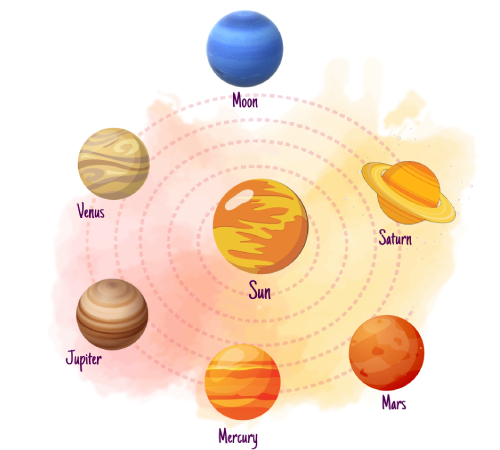
In astrology, planets are called Graha. The word Graha primarily means “seizer,” “grasper,” or “holder.” This meaning is important. A Graha is not only a physical body in the sky. It is an energy that influences the mind, behaviour, and life circumstances.
For example, the Sun represents self-confidence, authority, vitality, and identity. The Moon represents emotions, mental balance, and daily feelings. These meanings go beyond astronomy. They describe human qualities.
Vedic astrology recognizes nine primary planetary forces, known as the Navagraha. These include visible planets such as Mars, Mercury, Jupiter, Venus, and Saturn. It also includes Rahu and Ketu, which are eclipse points rather than physical planets.
Their influence is studied through their placement in signs and houses in the birth chart. A planet placed strongly tends to support growth in its area of control. A weaker placement may show delays or lessons in that area.
In simple terms, planets in astrology are indicators. They reflect patterns of energy at the time of birth and throughout life. They do not create fate on their own. Instead, they show tendencies, timing, and areas that require awareness.
When these planetary forces are understood clearly, astrology becomes structured and practical. It shifts from vague belief to a system based on observation, symbolism, and timing.
In simple terms, astronomy explains what exists in space. Astrology interprets what those celestial positions mean for human life.
In this page, we will discuss all nine planets, viz., Sun, Moon, Mars, Mercury, Jupiter, Venus, Saturn, Rahu, and Ketu, and the significance of their placement in different houses.
| Basis of Comparison | Graha in Astrology | Planets in Astronomy |
| Meaning | A Graha means “that which influences.” It represents a symbolic and energetic force. | A planet is a physical celestial body that orbits a star. |
| Nature | Spiritual and symbolic in interpretation. | Physical and scientific in nature. |
| Purpose of Study | Studied to understand personality, karma, timing, and life patterns. | Studied to understand structure, motion, atmosphere, and composition. |
| Number Considered | Nine primary Grahas are known as Navagraha. | Eight recognized major planets in the solar system. |
| Includes Sun and Moon | Yes. The Sun and Moon are treated as planetary influences. | No. The Sun is classified as a star and the Moon as a natural satellite. |
| Includes Rahu and Ketu | Yes. Rahu and Ketu are important karmic points. | No. Rahu and Ketu are not physical planets but mathematical eclipse points. |
| Focus | Influence on mind, behaviour, and life events. | Physical properties, gravity, orbit, and formation. |
| Method of Interpretation | Based on zodiac signs, houses, aspects, dashas, and transits. | Based on physics, mathematics, and observational data. |
| Role in Daily Life | Used for guidance in career, marriage, health, finance, and spiritual growth. | Used for space research, scientific discovery, and understanding the universe. |
In Vedic astrology, planets are seen as forces that shape tendencies, timing, and life themes. Their influence is not random. It follows a structured system based on placement, strength, and movement.
Below are the main ways planets influence human life.
At the moment of birth, the positions of the Sun, Moon, and other planetary bodies are recorded. This chart becomes a map of personality and life direction.
Each planet represents a specific area of life:
Sun reflects identity and confidence.
Moon reflects emotions and mental stability.
Mars reflects courage and action.
Mercury reflects communication and intellect.
Jupiter reflects wisdom and growth.
Venus reflects love and comfort.
Saturn reflects discipline and responsibility.
Rahu reflects ambition and desire.
Ketu reflects detachment and spiritual insight.
The condition of these planets shows natural strengths and areas that require effort.
The birth chart is divided into twelve houses. Each house governs a life area such as career, marriage, health, wealth, education, or family.
When a planet occupies a house, it influences that specific area. For example:
A strong Jupiter in the tenth house may support career growth.
Saturn in the seventh house may bring maturity and responsibility in marriage.
The house position shapes where the planetary energy is expressed.
Planets behave differently in different zodiac signs. Some placements increase strength, while others reduce it.
For instance, Mars placed in its own sign may express courage clearly. In a weaker sign, it may show hesitation or internal conflict. Sign placement modifies how a planet delivers results.
Vedic astrology follows a timing system known as Dasha. Each person experiences planetary periods during different stages of life.
When a planet’s period runs, its themes become more active. If Jupiter’s period begins, matters related to growth, knowledge, or guidance may become prominent. If Saturn’s period runs, responsibilities and long-term work may take focus.
This system explains why life changes in phases.
Planets continue to move after birth. Their current movement across the zodiac is called transit.
When a planet transits over key points in the birth chart, it activates events. For example:
Saturn transit may test patience and stability.
Jupiter transit may bring expansion and opportunity.
Transits influence timing rather than personality.
A planet’s influence also depends on its strength and its relationship with other planets. Supportive aspects can enhance results. Challenging aspects may create lessons that require awareness and maturity.
Planets do not force events. They indicate patterns, tendencies, and timing. Astrology works on the principle that cosmic movement reflects human experience.
When planetary influences are understood clearly, decisions can be made with greater awareness. Rather than predicting fixed outcomes, astrology offers insight into cycles, strengths, and opportunities for growth.