-
 Translate
- Astropatri Values
- My Account
Translate

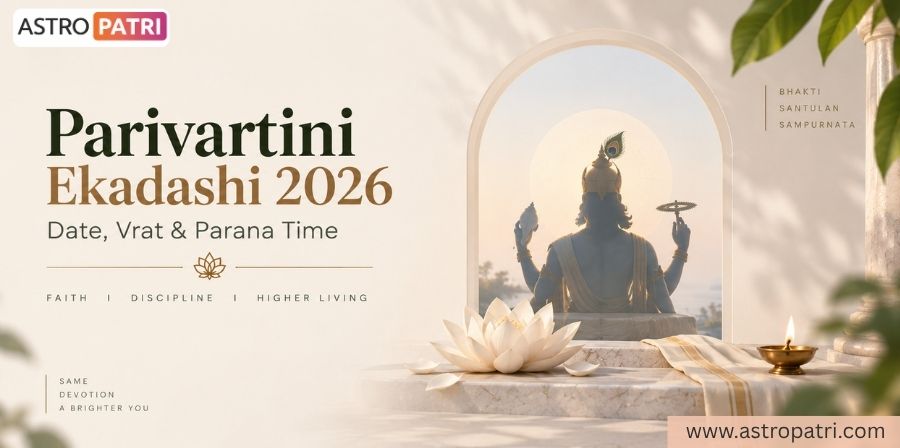
Parivartini Ekadashi 2026 falls on Tuesday, September 22. The fast will be broken on Wednesday, September 23, during the Parana period, with the exact timing depending on your location.
But this Ekadashi is not remembered only because of its fasting date. It gets its name from a beautiful tradition associated with Lord Vishnu’s change of sleeping posture during Chaturmas.
That symbolic turn is at the heart of Parivartini Ekadashi and gives the festival a deeper theme of change, renewal and turning towards a new direction.
Also known as Parshva Ekadashi, Vamana Ekadashi and Padma Ekadashi, the day is observed with Lord Vishnu worship, vrat, prayers and spiritual reflection. Its connection with the Vamana avatar and King Bali adds another layer to the story.
So, before the vrat begins, here is what you need to know about Parivartini Ekadashi 2026, including its date, Parana time, puja vidhi, fasting rules, Vamana Katha and significance.
Parivartini Ekadashi falls on Tuesday, September 22, 2026. The Ekadashi Tithi begins on September 21 evening and continues until September 22 night. Parana is observed on September 23.
For New Delhi, the Parana window is listed at approximately 6:09 AM to 8:35 AM on September 23. Since Parana depends on local sunrise and Panchang calculations, devotees in other cities should check the timing for their location.
Parivartini Ekadashi 2026: Important Timings
| Detail | Date and Time |
| Ekadashi | Tuesday, September 22, 2026 |
| Paksha | Shukla Paksha |
| Lunar Month | Bhadrapada |
| Ekadashi Tithi Begins | September 21, evening |
| Ekadashi Tithi Ends | September 22, night |
| Parana | Wednesday, September 23 |
| New Delhi Parana | Approximately 6:09 AM to 8:35 AM |
| Main Deity | Lord Vishnu |
| Associated Avatar | Vamana |
| Other Names | Parshva Ekadashi, Vamana Ekadashi, Padma Ekadashi |
The name Parivartini is associated with turning or changing.
During Chaturmas, Lord Vishnu is traditionally believed to be resting in yogic sleep. On this Ekadashi, he is believed to turn to another side while sleeping. This is why the day is also known as Parshva Ekadashi.
It sounds like a small detail, but it gives the festival a surprisingly relatable meaning.
A turning point in life does not always look dramatic. Sometimes it is simply deciding to look at something differently. Sometimes it is leaving behind an old habit, changing direction or finally accepting that the path you are on needs adjustment.
That symbolism sits quietly at the heart of Parivartini Ekadashi.
Parivartini Ekadashi is closely associated with Lord Vishnu’s Vamana avatar and King Bali.
According to the traditional story, King Bali was a powerful ruler known for his generosity and devotion. When his influence grew across the three worlds, Lord Vishnu appeared before him in the form of Vamana, a young Brahmin.
Vamana asked Bali for three steps of land.
Bali agreed.
Vamana then expanded to a divine form. With one step, he covered the earth. With the second, he covered the heavens. There was nowhere left for his third step, so Bali offered his own head.
The story is remembered through themes of devotion, humility, surrender and divine grace.
It is also why Parivartini Ekadashi is closely linked with Vamana. Vamana Jayanti is observed on the following day, September 23, 2026.
Parivartini Ekadashi is traditionally observed through fasting, prayer, Vishnu worship and self-restraint.
Its significance is closely tied to Chaturmas and the traditional belief that Lord Vishnu changes his sleeping posture during this period. The festival therefore carries both ritual and symbolic importance.
Devotees may use the day to slow down, pray, reduce distractions and spend more time in spiritual reflection.
Traditional beliefs also associate Ekadashi fasting with purification, devotion and spiritual merit. These are matters of faith and religious tradition, rather than guaranteed outcomes.
The exact routine can differ between families and traditions, but the basic observance is fairly simple.
Devotees generally begin by taking a bath and making a Sankalp for the fast. Lord Vishnu is then worshipped with prayers and traditional offerings.
During the day, devotees may chant Vishnu mantras, read devotional texts, listen to the Ekadashi Katha or spend time in quiet prayer.
The fast is continued according to one’s chosen fasting tradition and physical capacity.
On Dwadashi, the fast is broken during the appropriate Parana period.
The point of a vrat is not to prove how much discomfort you can tolerate. Devotion and sincerity remain an important part of the observance.
Ekadashi fasting rules vary, so not everyone follows the same type of fast.
Depending on the tradition and personal capacity, devotees may observe a stricter fast, a fruit-based fast or a lighter fasting routine. Foods commonly eaten during Ekadashi include fruits, milk, nuts, makhana, potatoes, sabudana and water chestnut.
Rice, wheat, beans, pulses and other grains are generally avoided during Ekadashi fasting. Some foods often used for vrat, such as buckwheat flour or samak rice, may be treated differently by different traditions, so it is sensible to follow the custom you normally observe.
If a strict fast is difficult for you, choose an approach that is appropriate for your health and tradition rather than treating fasting as a test of willpower.
A peaceful, devotional routine is enough.
Traditional observances also include devotional recitation and offerings to cows, Brahmins or others as prescribed by the family or community tradition.
The most familiar restriction is food.
Devotees generally avoid rice, grains, pulses and beans during the fast. Many also avoid alcohol and foods that do not fit their fasting tradition.
It is also important to break the fast at the proper time rather than whenever it is convenient. Parana is traditionally performed during the prescribed Dwadashi window.
Beyond food, the day is generally meant to encourage restraint and devotion. Excessive indulgence, unnecessary distractions and a purely mechanical approach to the vrat can take away from its spiritual purpose.
Lord Vishnu is traditionally believed to remain in yogic sleep during Chaturmas. On Parivartini Ekadashi, he is said to change his sleeping position, which is why the day is called Parivartini or Parshva Ekadashi.
The image of Vishnu turning over also gives the festival its symbolic heart.
A new direction does not always begin with a dramatic ending. Sometimes it starts with a small shift in perspective.
That is why the idea of “turning” fits this Ekadashi so naturally.
Parivartini Ekadashi is associated with Lord Vishnu’s Vamana avatar, and the traditional story centres on Vamana and King Bali.
The following day is associated with Vamana Jayanti, making the connection even more prominent during this period.
The story also adds another layer to the festival’s message. Bali has power, wealth and authority, but eventually his greatest act is surrender.
It is a reminder that sometimes strength is not about holding on tighter. It is about knowing when to surrender what needs to be surrendered.
Parivartini Ekadashi 2026 falls on September 22, with Parana on September 23.
But beyond the date and vrat rules, this Ekadashi carries a simple idea that still feels surprisingly relevant: sometimes, moving forward begins with a change in direction.
Lord Vishnu’s traditional turning during Chaturmas gives the festival its name, while the story of Vamana and Bali brings themes of humility, devotion and surrender into the picture.
So along with your prayers and vrat, take a moment to ask yourself:
What needs to change in my life?
Maybe it is a habit. Maybe it is a mindset. Maybe it is simply the way you have been looking at something.
Sometimes, a small turn is all it takes to begin moving in a new direction.
1. When is Parivartini Ekadashi 2026?
Parivartini Ekadashi will be observed on Tuesday, September 22, 2026. The Ekadashi Tithi begins on September 21 evening and ends on September 22 night.
2. What is the Parana time for Parivartini Ekadashi 2026?
For New Delhi, Parana is listed at approximately 6:09 AM to 8:35 AM on September 23, 2026. Timings can vary by city, so check the local Panchang for your location.
3. What can I eat during Parivartini Ekadashi?
Depending on the fasting tradition, devotees may have fruits, milk, nuts, makhana, potatoes, sabudana and water chestnut. Rice, wheat, grains, pulses and beans are generally avoided.
4. Why is Parivartini Ekadashi called Parshva Ekadashi?
It is traditionally believed that Lord Vishnu turns to his other side while resting during Chaturmas on this Ekadashi. This turning is associated with the names Parivartini and Parshva Ekadashi.
5. Is Parivartini Ekadashi connected with Vamana Jayanti?
Yes. Parivartini Ekadashi is associated with Lord Vishnu’s Vamana avatar and the story of King Bali. Vamana Jayanti is observed on the following day, September 23, 2026.